Scientists have developed a new particle detector that can measure incredibly short bursts of electrons lasting just one trillionth of a second, or one picosecond. The breakthrough could help next-generation particle accelerators reveal how materials, chemicals and biological systems behave at the atomic level. The new detector was created by the Advanced Accelerator Diagnostics Collaboration, [……
Description NASA astronaut Jessica Meir inspects optical fibers while installing hardware updates to the agency’s Cold Atom Lab, or CAL, aboard the International Space Station on May 8, 2026. About the size of a minifridge and operated from Earth, CAL chills atoms to temperatures below minus 459 degrees Fahrenheit (minus 273.15 degrees Celsius), so close […] The post Astronaut Jessica Meir Assist…
atomic-physicsopticsphysics
Google News Content : ScienceAlert : The Best in Science News and Amazing Breakthroughs
Consider a light source, like lamb, that radiates photons in vacuum. Can we detect a particular photon, moving in a specific direction, always at one point or the photon is localised and moves from one point to another? In other words, I would like to know that like free quantum particles... Read more
If we release an electron around a positively charged sphere, the initial state of electron is a linear combination of Hydrogen-like states. According to quantum mechanics, evolution of time would not change this initial state because the potential is time independent. However, classically we... Read more
Nature Communications, Published online: 05 June 2026; doi:10.1038/s41467-026-73441-1 This review outlines the evolution of timekeeping, focusing on atomic clocks and time dissemination methods, underpinning modern technologies such as GNSS and communication networks and enabling emerging applications such as quantum communication, while addressing future directions in global synchronization and …
I have 2 question about matter and atoms. I’m trying to learn here, excuse my ignorance :/ 1. Is it possible for matter to be completely destroyed at the atomic level so that it no longer exists at all? For instance, if you exposed ashes to extremely high temperatures, such as those found in... Read more
So, I've just studied Schrödinger Equation and it's application in the hydrogen atom. At first, I understood it well but then, I kinda lost it and it ended up as "Quantum Numbers". Now I remember having them at high school, but I don't understand how the equation ended up as the quantum numbers... Read more
Application deadline: Tuesday, June 30, 2026 Employer web page: http://iqs.berlin Job type: PhD PostDoc Tags: quantum optics metrology atomic physics Laser systems Space-system engineering PhD and PostDoc positions are available in the PHOENYX project at Humboldt-Universität zu Berlin. PHOENYX aims to bring optical clock technology closer to real space applications by preparing core components of…
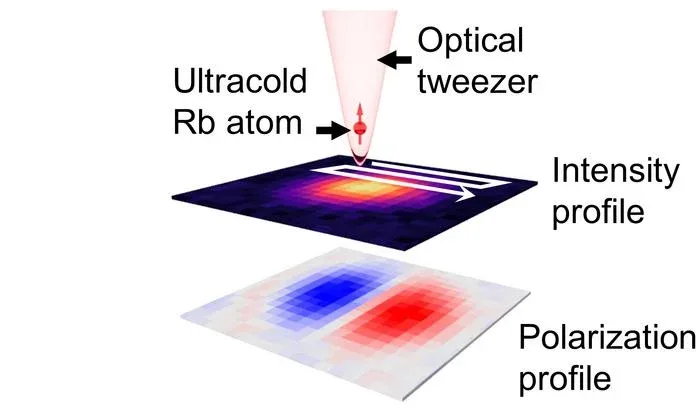
Physicists Turn a Single Frozen Atom into a Camera That Sees Light Below the Diffraction Limit
Conceptual illustration of the Atom Camera. A single ultracold rubidium (Rb) atom trapped in an optical tweezer is spatially scanned to visualize the intensity and polarization distributions of a light pattern.
Scientific Reports, Published online: 28 May 2026; doi:10.1038/s41598-026-51873-5 The miniaturized vacuum system for cold atom sensors based on the technology of passive vacuum
Nature, Published online: 27 May 2026; doi:10.1038/s41586-026-10556-x A measurement of the hyperfine splitting energy of the ground state of antihydrogen at 4 ppm precision reaches a point at which this result is sensitive to the internal structure of the antiproton.
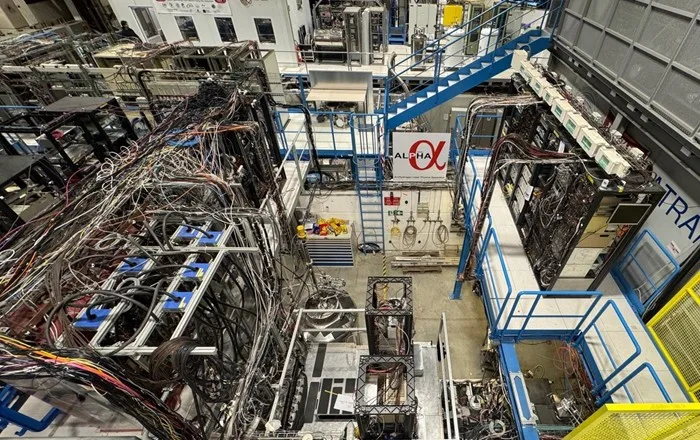
Swansea University physicists, as leading members of the ALPHA antihydrogen collaboration at CERN, have determined the ground state hyperfine splitting of antihydrogen 100 times more accurately than ever before.
atomic-physicsphysics
Google News Content : ScienceAlert : The Best in Science News and Amazing Breakthroughs
The fine-structure constant α appears whenever the electron resists forced reorientation by an external field: - Anomalous moment: precession deficit per cycle, ##(g-2)/2 = \alpha/(2\pi) + \ldots## - Zeeman: the measured ##g \neq 2## is the same anomaly seen as an energy splitting rather than a... Read more
The CODATA value of ##e/m_e## comes from Penning-trap cyclotron frequency measurements (strong ##B## field). Are there any competitive determinations of the same ratio ##e/m_e## using purely electric methods (no ##B##)? For instance from LINAC kinematics or Duane-Hunt bremsstrahlung? The papers... Read more
Statement of the problem : The problem is a solved example in Kleppner and Kollenkow's book, p. 21. The example is titled : "The Effect of a Radio Wave on an Ionospheric Electron". I copy and paste the example below and underline the last bit in red , which is my area of doubt... Read more
Nature, Published online: 20 May 2026; doi:10.1038/s41586-026-10485-9 Bright squeezed vacuum light boosts nonlinear atomic tunnelling ionization more than 20-fold compared with coherent light, enabling quantum control of strong-field processes without increasing classical intensity.
I have always been fascinated the idea that electrons “pop in and out of existence” around an atom but from what I’ve read, they’re not “popping in and out of existence. What is actually going on? Could it be the quantum foam?
atomic-physicsphysicsquantum-physics
research.io
Sign up to keep scrolling
Create your feed subscriptions, save articles, keep scrolling.











 research.io