gravitational-waves

The Daily Galaxy –Great Discoveries Channel
Latest from Space.com
Lifeboat News: The Blog

A prototype quantum sensor developed by researchers at Imperial has demonstrated for the first time that a key principle behind next-generation quantum detectors can work under realistic conditions. The study shows how comparing two long-baseline atom interferometers, instruments that use lasers to precisely measure the behavior of atoms, allows experimental noise to be effectively canceled. [&#8…

astronomygravitational-wavesphysicsquantum-physics
Nature Astronomy

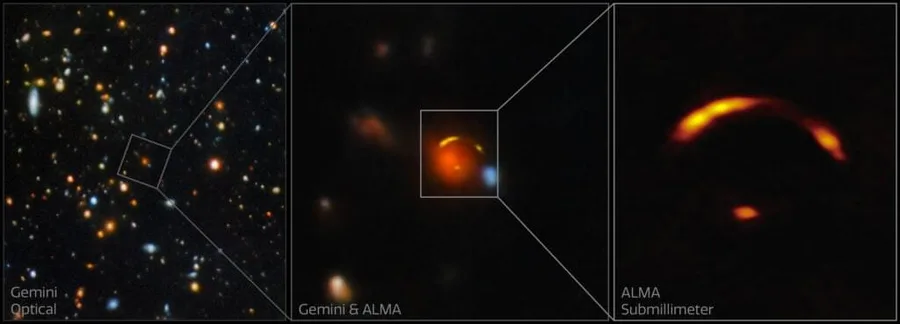
Nature Astronomy, Published online: 17 June 2026; doi:10.1038/s41550-026-02884-9 A gravitationally lensed, obscured starburst galaxy about 11 billion years ago may be associated with a high-energy neutrino. If so, this reveals a new type of cosmic source and opens a window on multi-messenger astronomy at cosmological distances.

astronomyastrophysicscosmologygravitational-waves
e-Publications@Marquette

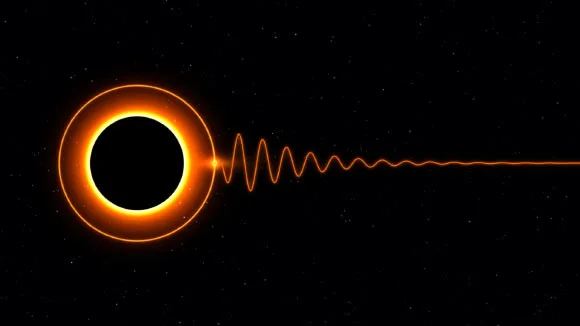
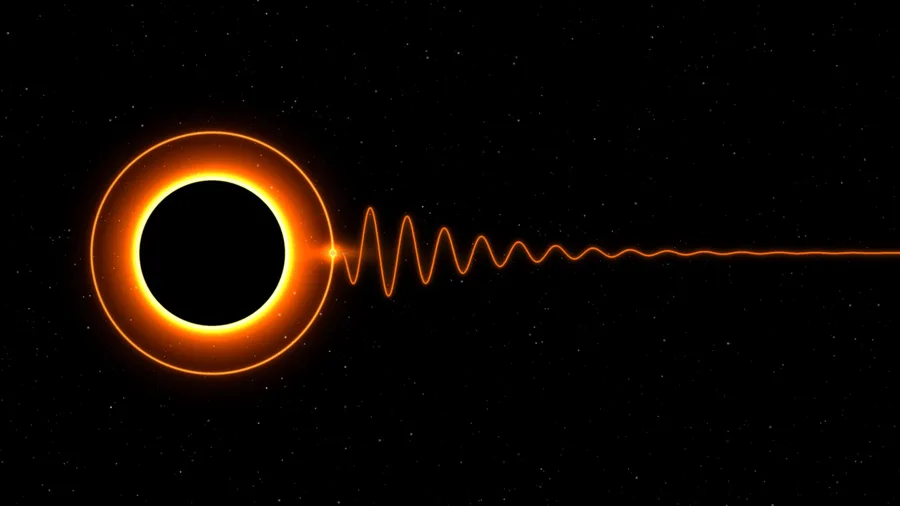
The binary black hole signal GW250114, the loudest gravitational wave detected to date, offers a unique opportunity to test Einstein’s general relativity (GR) in the high-velocity, strong-gravity regime and probe whether the remnant conforms to the Kerr metric. Upon perturbation, black holes emit a spectrum of damped sinusoids with specific, complex frequencies. Our analysis of the postmerger sig…

astronomycosmologygravitational-waves
Universe Today
Mark Thompson (https://www.universetoday.com/authors/mark)
6d ago

We are used to thinking of gravitational waves as messengers from catastrophes in space, the ringing of spacetime after black holes collide for example. But our own Galaxy hums with a fainter, steadier signal, a chorus of millions of unseen binary stars. A new study has found that this hum carries a hidden fingerprint of the Milky Way's spin, and that if a future space mission ignores it, our pic…

astronomyastrophysicsgravitational-waves
SciTechDaily

A new detector-based method clarifies how gravitational waves should be measured in an evolving universe. Imagine trying to measure a ripple on the surface of a pond while the pond itself is slowly changing shape. That is the challenge scientists face when they study gravitational waves not as isolated signals from colliding black holes, but [...]

astronomygravitational-waves
The Daily Galaxy –Great Discoveries Channel
SciTechDaily

A new gravitational-wave catalogue reports 161 additional black hole mergers, bringing the total to 390 detections. Scientists at the University of Glasgow’s Institute for Gravitational Research are celebrating the release of a major new collection of gravitational wave discoveries, a milestone that highlights the rapid growth of gravitational astronomy. The latest Gravitational Wave Transient Ca…

astronomyastrophysicsgravitational-waves
SciTechDaily

Scientists believe an unusual LIGO detection may be evidence of a primordial black hole, potentially linking these long-theorized objects to the mystery of dark matter. Scientists at the University of Miami believe they may be closing in on evidence for one of the most elusive objects in the universe: primordial black holes. While definitive proof [...]

astronomycosmologygravitational-waves
OzGrav

OzGrav is delighted to congratulate Professor David Blair, one of Australia’s pioneering gravitational-wave physicists, on being appointed an Officer of the Order of Australia (AO) in the 2026 King’s Birthday Honours. Professor Blair was recognised for his distinguished service to physics, precision measurement science, gravitational-wave research and scientific education. A founding figure in Au…

astronomyastrophysicsgravitational-wavesphysics
Astronomy Magazine

In early 1987, a team led by MIT’s Jacqueline Hewitt was imaging radio-emitting objects with the Very Large Array radio telescope as part of a gravitational lens survey. The unusual appearance of object MG1131+0456 – an oval with elongated bright spots at the ends – led to further investigation, and the researchers eventually concluded it Continue reading "June 9, 1988: First image of an Einstein…

astronomycosmologygravitational-waves
nLab
Urs Schreiber
12d ago

See also: Including strange quarks: Including sigma-meson and omega-meson: Observation of gravitational waves coincident with electromagnetic radiation from merging neutron stars: Discussion of models of neutron stars by Skyrmions: C. Adam, Carlos Naya, J. Sanchez-Guillen, R. Vazquez, A. Wereszczynski, BPS Skyrmions as neutron stars, Physics Letters B Volume 742, 6 March 2015, Pages 136-142 (arXi…

astronomyastrophysicsgravitational-waves
Physics Forums

Hello, I am Andrew Jeremiah, an independent researcher from Brazil with a background in architecture. I have developed a geometric framework for emergent gravity — Quantum Granodynamics of Spacetime (QGDS) — in which spacetime is modeled as a collection of topological boundaries between two... Read more

astronomycosmologygravitational-wavesphysics
Knowridge Science Report

A pair of stars spiraling around each other. That’s the origin of a new source of repeating radio bursts we’ve detected, called ASKAP J1745. In recent years, astronomers have been puzzling over mysterious bursts of radio signals, known as long-period transients because of how slowly they repeat. They were first discovered by chance with telescopes […] The post Mysterious signals keep coming from …

astronomyastrophysicsgravitational-waves
Frontiers in Astronomy and Space Sciences | New and Recent Articles

Gravitational-wave detection provides humanity with unique access to extreme astrophysical and cosmological phenomena. In space-based missions, however, the Doppler frequency pulling induced by orbital motion severely limits the precise extraction of gravitational-wave signals. This work shows that by introducing properly designed low-pass filters into established laser arm-locking systems, it is…

astronomycosmologygravitational-wavesspace-exploration
Lifeboat News: The Blog

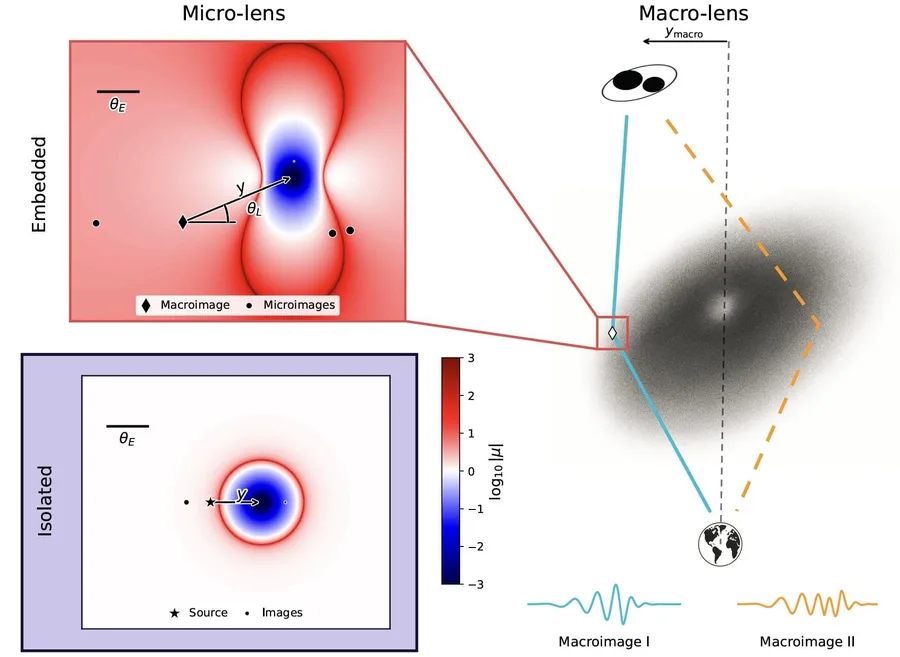
Gravitational waves are tiny ripples in spacetime. Their first direct detection in 2015 marked a revolutionary moment in astronomy. Today, we have a thorough understanding of signals that travel far from their sources through quiet, nearly empty space, such as those emitted when black holes merge. In this case, the wave can be considered a […]

astronomygravitational-waves
SciTechDaily

Researchers discovered a closely orbiting pair of supermassive black holes in Markarian 501 by tracking two jets of particles. The binary system could merge within 100 years and may produce detectable gravitational waves. Current evidence indicates that nearly every large galaxy contains a supermassive black hole at its center, with a mass ranging from millions [...]

astronomyastrophysicsgravitational-waves
Nautilus
Nature Astronomy

Nature Astronomy, Published online: 01 June 2026; doi:10.1038/s41550-026-02856-z The mass spectrum of binary black-hole mergers has been expected to show a ‘mass gap’ above 45 solar masses, consistent with the physics of pair-instability supernovae. An extensive catalogue of gravitational-wave detections reveals a high-spin population above this threshold that probably results from repeated black…

astronomyastrophysicsgravitational-waves
research.ioresearch.io

Sign up to keep scrolling

Create your feed subscriptions, save articles, keep scrolling.

Already have an account?