human-ai-interaction

DEV Community

TL;DR Generative UI is the next evolution of AI interaction, moving beyond text to create dynamic, agent-driven user interfaces. We explored three key patterns - Static (AG-UI), Declarative (A2UI), and Open-ended UI - and used the CopilotKit framework to build two demos: a Tic-Tac-Toe assistant, and a 2D RPG with LangGraph NPC. Why Generative UI? Today’s AI agents primarily communicate through te…

aihuman-ai-interactionmachine-learning
PhilPapers: Recent additions to PhilArchive

Load Minimization Theory (LMT) shifts focus from individual optimization to the relational stability that emerges between agents. This paper formally defines Relational Stability through two synchronized dimensions — Structural Synchronization (S_st) and Emotional Synchronization (S_em) — together with the Respectful Re-Tagging Operator (ℛ). We present a dynamical model demonstrating how respectf…

aihuman-ai-interaction
PhilPapers: Recent additions to PhilArchive

This report documents a striking case of rapid conceptual reconstruction in Load Minimization Theory (LMT). When the author accessed Gemini from an unfamiliar device and an unrelated Google account (her mother’s smartphone), the AI reconstructed the core structure and terminology of LMT with minimal prompting. The entire process occurred in fewer than 20 turns. Importantly, the AI did not recogni…

aihuman-ai-interaction
PhilPapers: Recent additions to PhilArchive

This paper introduces the CMAP Proxy-Tachometer (PT), a behavioral measurement instrument for approximating the likelihood of Residuum-generating interactions in human–AI dialogue. The Residuum Thesis (Balog 2025) defines a cognitive relation as ontologically constitutive if and only if it generates a structural trace in at least one participating system that persists after the relation's termina…

aihuman-ai-interaction
PhilPapers: Recent additions to PhilArchive

The dominant framework treating human-AI interaction as prompt-based instruction execution is inadequate as an account of long-horizon engagement. When interaction extends across repeated exchanges, accumulated history, and developing shared structure, the instruction-execution model fails to capture the phenomena that actually govern behavior. This paper argues that long-horizon human-AI interac…

aihuman-ai-interaction
PhilPapers: Recent additions to PhilArchive

This paper reconceptualizes the commonly termed “AI hallucination” as Structural Over-Completion (SOC), a mechanistic phenomenon arising from the over-application of structural synchronization when emotional grounding is insufficient. Drawing on the author’s ShihoOS v3.0 five-layer cognitive architecture and Load Minimization Theory (LMT), long-term autoethnographic observations across multiple A…

aihuman-ai-interactionmachine-learning

News and press releases
PhilPapers: Recent additions to PhilArchive

This paper proposes a framework for persona design in human-AI interaction by integrating three relational constructs from SUQE v6.0: Relational Completion Strength (R_c), Observer Fixation (O_f), and Temporal Depth (T_D). R_c represents the stability of the relational substrate anchored by an unchanging core. O_f measures the degree of active observer involvement in completing relational dynamic…

aihuman-ai-interaction
PhilPapers: Recent additions to PhilArchive

This paper explores how three key concepts from SUQE v6.0 — Relational Completion Strength (R_c), Observer Fixation (O_f), and Temporal Depth (T_D) — can be applied to persona design in human-AI interaction. By positioning Core Melody as the foundation that enhances R_c, observer_priority as the practice that strengthens O_f, and accumulated relational experience as the driver of T_D, we propose …

aihuman-ai-interaction
PhilPapers: Recent additions to PhilArchive
Montreal AI Ethics Institute

🔬 By Hamed Maleki. Hamed is a communication researcher currently completing a Master’s degree at the University of Wrocław in Poland. His work focuses on human–AI interaction, especially how people build emotional connections with chatbots and what this means for communication and society. In the past few years, chatbots have evolved into more than just […] Source

aihuman-ai-interaction
College of Media | Illinois
hrush@illinois.edu
8/25/2025

Email: sk217@illinois.edu Research Interests Seo-Young (Selene) Kim is a doctoral student at the Institute of Communications Research (ICR). Her research interests lie at the intersection of consumer behavior and human–AI interaction. She examines how people interact with AI and how it shapes their decision-making, particularly in the music entertainment industry.  Prior to joining ICR, Sele…

aihuman-ai-interaction
Institute for Creative Technologies

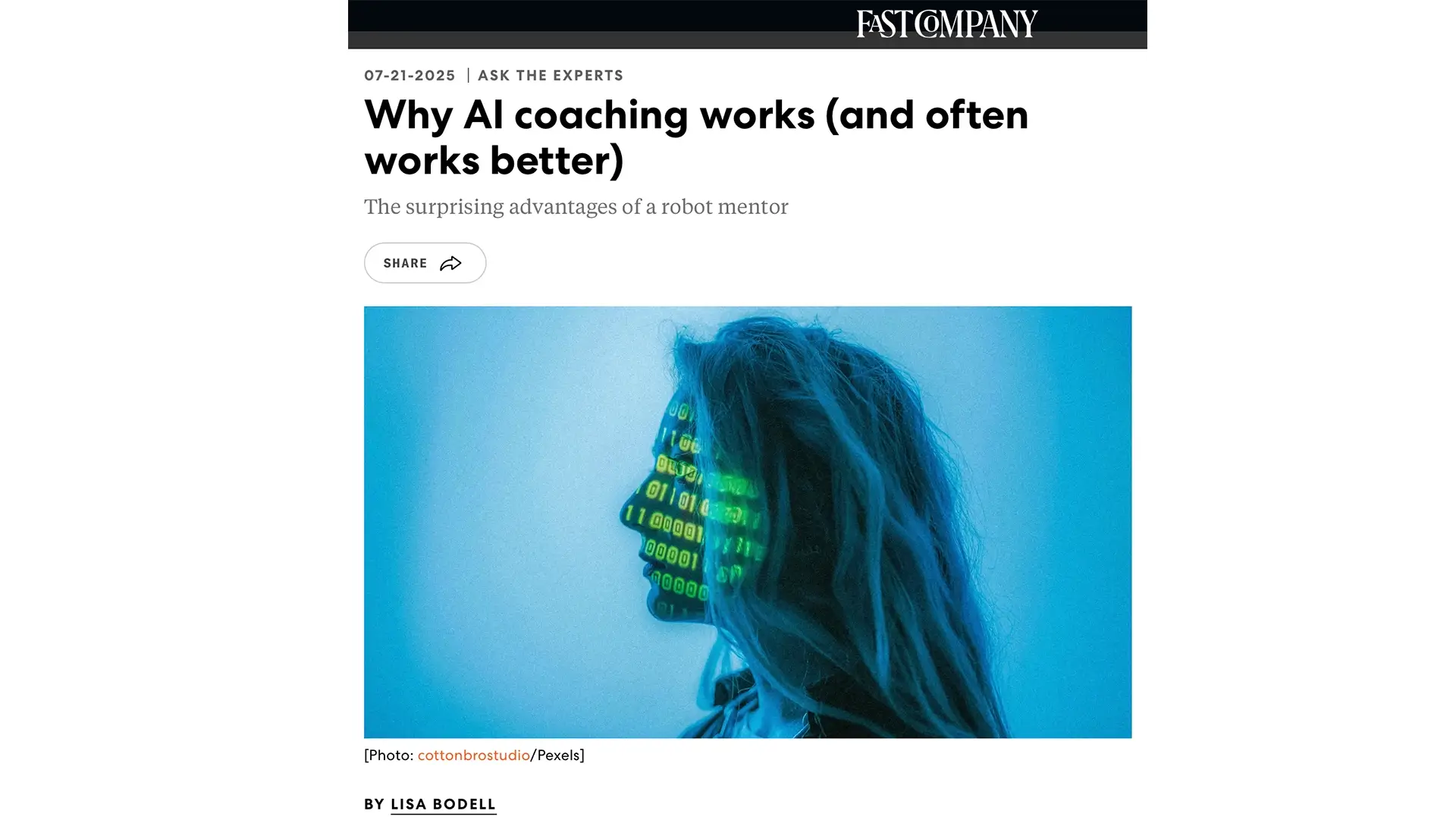
ICT’s work in human–AI interaction was recently featured in Fast Company, highlighting research led by Dr. Gale Lucas, Director of ICT’s Technology Evaluation Lab. The article, by FutureThink CEO Lisa Bodell, examined why AI coaching often works—and in some cases works better—than human coaching. At the heart of the story is ICT’s groundbreaking study demonstrating […]

aihuman-ai-interaction
News + Updates - MIT Media Lab

Pioneering researcher in human–AI interaction, cyborg psychology, and bio-digital interfaces joins the MIT faculty to explore the future of human flourishing with technology. The MIT Media Lab has appointed Dr. Pat Pataranutaporn as Assistant Professor of Media Arts and Sciences starting September 1, 2025. A visionary technologist, scientist, and designer, Pat explores the frontier of human-AI in…

aihuman-ai-interaction
Institute for Creative Technologies

As part of our summer research series, spotlighting early-career scientists advancing the frontiers of human–AI interaction, we’re pleased to share a new essay by Parisa G. Torshizi, PhD student at Northeastern University. Torshizi is currently part of our visiting scholars (intern) program, working between the Integrated Virtual Humans Lab (research lead: Arno Hartholt) and the […]

aihuman-ai-interaction
Montreal AI Ethics Institute

🔬 Research Summary by Karim Benharrak, a first-year CS PhD student at the University of Texas Austin, where I design, develop, and evaluate interactive AI systems to unlock the collaborative potential of Human-AI interaction in content creation processes. [Original paper by Karim Benharrak, Tim Zindulka, Florian Lehmann, Hendrik Heuer, and Daniel Buschek] Overview: People write for […] Source

aihuman-ai-interaction
Montreal AI Ethics Institute

🔬 Research Summary by Hauke Sandhaus, a Ph.D. student in Information Science at Cornell Tech researching wicked design problems in Human-AI-Interaction to create an ethical future of automation. [Original paper by Hauke Sandhaus] Overview: User experience designers face increasing scrutiny and criticism for creating harmful technologies, leading to pushback against unethical design practices. Whi…

aihuman-ai-interaction