Recent cannabis use might make higher doses of nicotine feel more unpleasant, according to new research. Scientists discovered that cannabis alters our subjective reaction to the drug without necessarily changing how much we want it.
IntroductionThe reduction of α7 nicotinic acetylcholine receptor (nAChR) in the hippocampus con-stitutes one of the neuropathological features observed in the brains of individuals with Alzheimer’s disease (AD), and α7 nAChR is crucial to cognitive process. However, studies involving α7 nAChR knockout mice have not demonstrated any abnormal brain structure or damage to hippocampal neurons, a disc…
IntroductionGlutamate‐induced neurotoxicity is a shared pathological mechanism across neurodegenerative and neuropsychiatric disorders, but the mechanistic contributions of the sigma‐1 receptor remain unsolved and underappreciated.MethodsThis scoping review focuses on the pharmacological gaps in σ1R agonists by synthesizing mechanistic and bibliometric trends across the most influential literatur…
Today, OpenAI’s Chief Scientist acknowledged that we’ve reached that threshold—calling modern AI an “alien mind” that operates more like complex neuroscience than traditional software. OpenAI’s Chief Scientist Jakub Pachocki: “Based on internal results, I have a strong expectation that this speed of progress could be sustained into recursive self-improvement.” (via Chubby) Jakub Pachocki reflects…
Neuropsychopharmacology, Published online: 05 September 2026; doi:10.1038/s41386-026-02552-6 Menstrual cycle-dependent white matter microstructural dynamics in women with substance use disorder
In mouse models, prophylactic psilocybin prevented or reduced multiple features of chemotherapy-induced peripheral neuropathy, with cycle-matched dosing sustaining protection during repeated cisplatin exposure without measurably affecting tumor growth. Experiments in human-derived sensory neurons and ex vivo peripheral nerves linked the effect to 5-HT2A-dependent preservation of mitochondrial tra…
Would you want to be the CEO of a large organization? Why or why not? Whether you like it or not, you already are, in a way, steering the most important system you have: your brain.
_Journal of Neurobehavioral Sciences_ 13 (2):77-87. 2026Living beings bring more order to the world, and are required by the second law of thermodynamics to simultaneously produce more disorder through metabolic heat dissipation. Consciousness in living beings produces even more order, enhancing survival and reproduction, and incurs an entropy debt that must be paid separately, and non-metabolica…
Researchers may have found a new way to weaken glioblastoma’s defenses against treatment. Blocking a protein called SET prevented tumors from forming in preclinical models, while targeting related proteins made cancer cells more vulnerable to radiation. The strategy works by restoring activity of PP2A, an enzyme that glioblastoma cells appear to suppress. Human testing will be needed to determine…
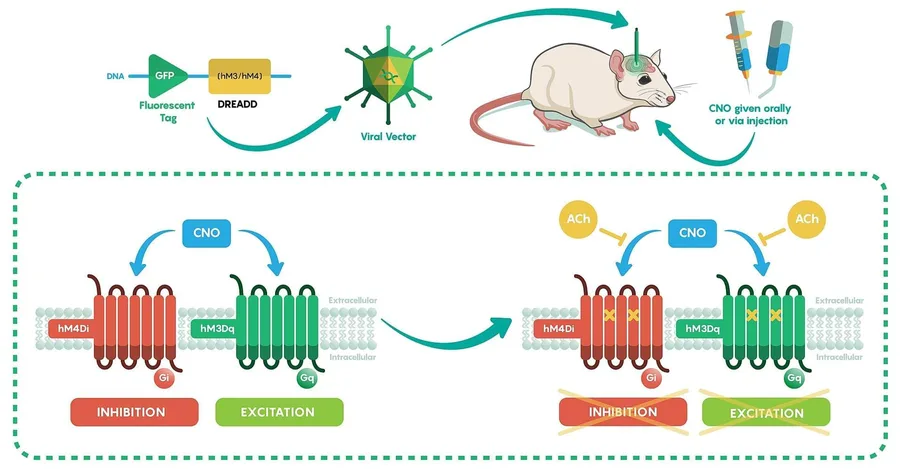
An excellent overview and analysis by Patrick Mineault on the exciting news that 7 chemogenetics clinical trials have begun in China! I very much hope that these trials show enough promise that they stimulate further work in this area. Spotlight on DREADDs and chemogenetics.
npj Science of Learning, Published online: 05 September 2026; doi:10.1038/s41539-026-00453-3 CGRP inhibition in the PBN shifts defensive strategy from freezing to active avoidance in a platform-based active avoidance paradigm
BackgroundRepetitive transcranial magnetic stimulation (rTMS) is a well-established neuromodulation technique for post-stroke motor rehabilitation with a favorable safety profile. However, its safety in patients with acute/subacute cerebral infarction remains incompletely characterized, particularly regarding unusual behavioral responses. Gelastic seizures, characterized by stereotyped, inappropr…
Nature Neuroscience, Published online: 04 September 2026; doi:10.1038/s41593-026-02434-6 This study argues that neuromodulation should harness the brain’s natural compensatory adaptations, rather than solely restore healthy-like dynamics, providing a framework for improving cognition in psychiatric and aging populations.
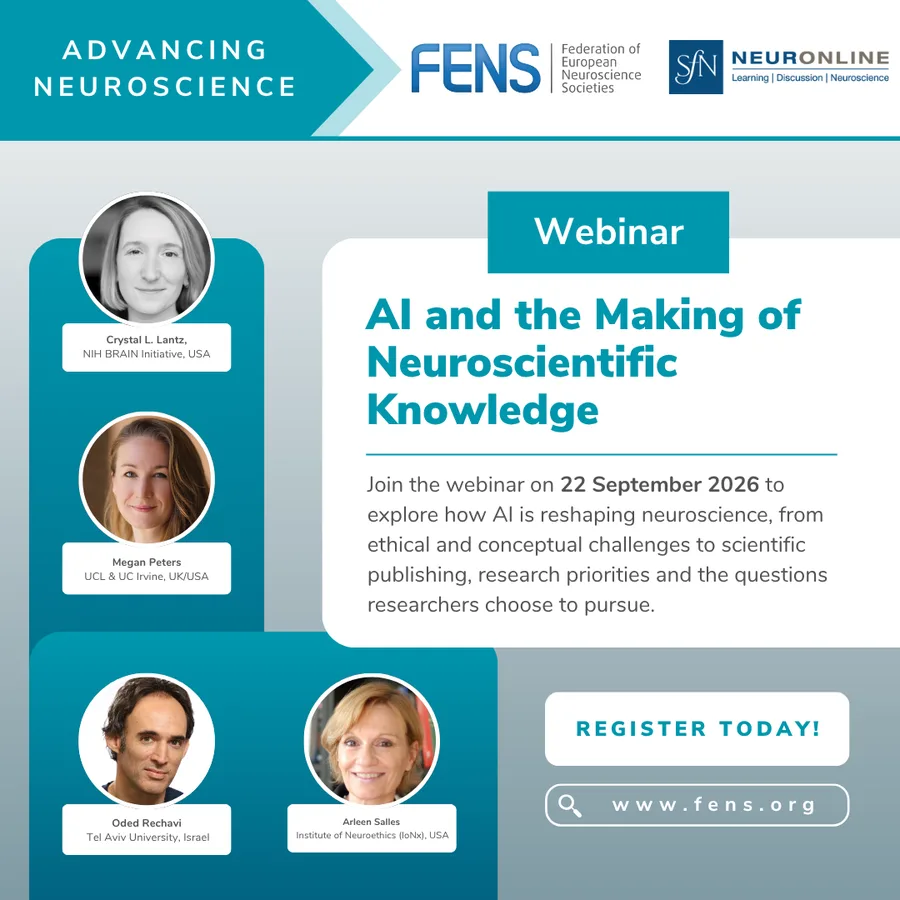
Registration is open for the FENS Committee on Higher Education and Training (CHET) and SfN Neuroscience Training Committee (NTC) webinar, “AI and the Making of Neuroscientific Knowledge”, taking place on Neuronline on 22 September 2026, 17:00–18:00 (CEST). Artificial intelligence (AI) has moved from a tool used by neuroscientists to a participant in how the field produces and evaluates knowledg…
IntroductionSensorimotor rhythm (SMR) neurofeedback has attracted growing interest for improving performance in precision sports; however, inter-individual variability in responsiveness remains poorly understood, and its associations with autonomic regulation and shooting performance have not been examined within a single-session paradigm. Because a substantial proportion of trainees show limited…
BackgroundTranscranial alternating current stimulation (tACS) is a noninvasive neuromodulation technique that can enhance motor function. The striatum is a central hub for motor control and β-band oscillations, and its tyrosine hydroxylase-positive interneurons (THINs) are modulated by dopamine. However, whether THINs are associated with motor changes following tACS through β-band synchrony has n…

 research.io