
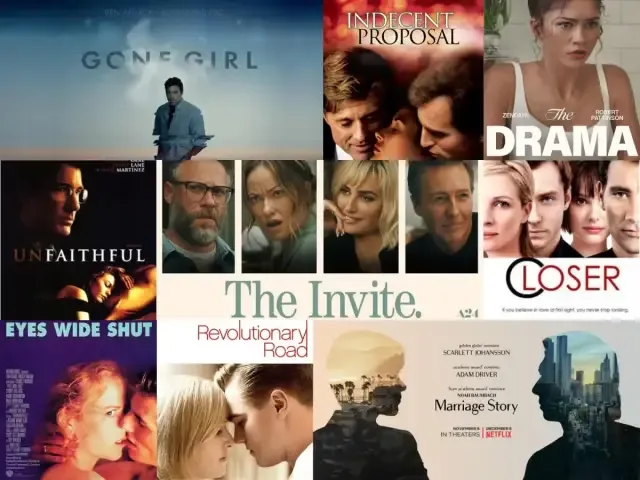

Movie date nights have long been a ritual of romance, from first dates to married couples’ standing nights out. You can probably name movies that leave you feeling warm, hopeful, excited, stimulated, and sometimes a little more in love with your partner.
But sometimes, the movies we watch become more than that—they become conversation starters, litmus tests, or unexpected mirrors of our own relationships.
These nine movies expose the underbelly of romantic relationships: the resentments, fantasies, secrets, compromises, and alternative lives that can coexist alongside love. Watching them runs the risk of cracking open a door that would be better kept closed, for the longevity of your relationship.
Last month’s The Invite, starring and directed by Olivia Wilde, tops our list of nine movies you might want to watch without your partner—or at least be very sure you know what conversation you’re signing up for in the post-screening debrief. Each movie asks a question that might be safer left unanswered.
- The Invite (2026)
What happens when you say the quiet part out loud?
The Invite turns the dinner-party setup into an examination of everything couples are usually too embarrassed, jealous, or afraid to say to each other.
Angela (Wilde) and Joe (Seth Rogen) portray a married couple whose relationship has become strained by years of resentment and disappointment. When Angela invites their upstairs neighbors, Piña (Penélope Cruz) and Hawk (Edward Norton), over for dinner, what begins as an attempt at connection becomes a much more revealing conversation about sex, attraction, love, and what people want from their partners, when they’re being honest.
As Piña and Hawk probe the tension between Angela and Joe—also glimpsed through their apartment windows and in elevator encounters—they force the quiet parts of the other couple’s relationship into the open. The questions Angela and Joe were afraid to ask each other come to the surface, like, “Do we love each other anymore? Can we salvage this relationship? Do you want to be with someone new?”
“Novelty is a powerful aphrodisiac. In long-term relationships especially, cultivating novelty—whether through stories or experiences—is key for sustaining passion,” says Esther Perel, sex therapist and consultant on The Invite, on her blog. “Maintaining a sense of mystery and surprise helps counteract the routine and repetition that can sometimes lead to a decline in desire over time.”
We tend to think of monogamy as a set of universally accepted rules: Don’t sleep with someone else. Don’t cross the line. But long-term relationships are also built on unspoken knowledge about what our partner wants, what they find attractive, what they would never do, and what they might secretly wish they could do. Lifting the lid on that box may reveal that the relationship is beyond repair.
- Indecent Proposal (1993)
What’s more important: Love or money? Would you risk the former for the latter? Can a couple withstand different answers to this question?
David (Woody Harrelson) and Diana (Demi Moore) are a financially struggling, yet happily married, couple, who are offered $1 million if the wife spends one night with a wealthy stranger, played by Robert Redford. The movie takes a question that sounds like a parlor game and puts it inside a marriage: What, exactly, would you be willing to sacrifice for a life-changing amount of money?
Diana’s decision to revisit the proposal after David’s initial hesitation—an uncomfortable pause that both she and the audience notice—begins her agreed-upon one-night stand.
From there, suspicion and mistrust begin to take hold, gradually eroding the relationship and ultimately pushing Diana toward the wealthy stranger.
What happens when a hypothetical becomes real? When money, desire, jealousy, and pride enter a marriage, it becomes much harder to separate what you thought you would do from what you did.
Indecent Proposal can turn a hypothetical into an uncomfortable inventory of your partner’s values—and your own.
Although it’s not every day a millionaire asks to sleep with a spouse, the question, and the length of the pause before answering, can reveal a lot about both sides.
- Unfaithful (2002)
Can anyone be tempted, and can one handle the consequences of infidelity?
Unfaithful, starring Diane Lane and Richard Gere, is a movie about a married suburban woman who meets a younger man and becomes increasingly drawn to him. There is no grand declaration that her marriage is over, no decision to go looking for an affair. There is simply attraction, followed by curiosity, a series of small choices that gradually lead down a road from which there is no return.
Some people believe that infidelity happens only to certain kinds of couples—unhappy couples, disconnected couples, couples whose marriages were already in trouble. But some people in loving relationships can still notice other people, feel chemistry, or wonder what it would be like to be with someone else.
In fact, that is part of what sucks you into Unfaithful: Richard Gere’s character is a quintessentially good husband—a devoted father, attentive partner, and decent man.
“I often find that the affair is a form of self-discovery. It’s not that the individuals having the affairs want to leave their partners, but the people they have become. They are looking for another version of themselves—which is the most powerful variety of ‘other’ there is,” says Perel in an interview with Goop.
A crush can remain a crush. A fantasy can remain a fantasy. But sometimes people begin feeding the attraction, creating opportunities to see the person again, or keeping secrets that gradually become more important than the relationship they are protecting.
Interesting fact: Both Indecent Proposal and Unfaithful were directed by Adrian Lyne, who’s been married since 1974 to his wife Samantha.
- Marriage Story (2019)
Can you love someone and still need to leave them?
Marriage Story begins with a husband and wife listing the things they love about each other. It’s tender enough to feel like the opening of a great romance, but the film quickly reveals a more complicated reality. Inspired by director Noah Baumbach’s own divorce, the story explores what happens when the things we love about our partner begin to pull us in different directions.
Charlie (Adam Driver) loves that Nicole (Scarlett Johansson) makes people feel comfortable, knows how to handle difficult family situations, plays with their son, knows when to push him and when to leave him alone. Nicole loves Charlie’s determination, his energy, his intelligence, and the way he throws himself into the things he loves.
It is an intimate portrait of a couple who, despite everything that will follow, genuinely know and admire one another.
The film follows Charlie and Nicole through the painful mechanics of divorce: lawyers, custody arrangements, money, competing versions of the marriage, and the realization that ending a relationship does not mean you stop having to deal with the person you are leaving.
Nicole has spent years adapting herself to Charlie’s life and putting parts of her own ambitions aside. Charlie has built a career and a world around his creative work but has failed to recognize how much his wife has sacrificed to support it. Neither is simply the villain. Neither is simply the victim.
That is one of the film’s most uncomfortable truths about long-term relationships: Love does not necessarily disappear before a marriage ends. Their issues aren’t due to flat-out incompatibility; they are problems of identity, compromise, resentment, and the slow accumulation of problems that were never fully addressed.
Another question the movie asks is whether love is enough to make a marriage work.
- Gone Girl (2014)
Do we really know our partners?
Gone Girl turns marital secrets into psychological warfare; this is anything but a love story.
Based on Gillian Flynn’s novel, the film follows Nick Dunne (Ben Affleck) on the day his wife, Amy (Rosamund Pike) disappears. As the investigation unfolds, the image of their marriage begins to unravel, leaving everyone—including the audience—to wonder whether Nick killed her.
At the heart of the film is a deeply unsettling possibility about how little access we have to another person’s reality.
One of the qualities that relationship researchers have found important is emotional responsiveness: the feeling that your partner understands you, validates your perspective, and cares about your well-being. In other words, a healthy relationship depends less on “I know everything about you” than on “I feel safe being known by you.”
- Eyes Wide Shut (1999)
Is fantasy a form of betrayal?
In Eyes Wide Shut, Alice (Nicole Kidman) and Bill Harford (Tom Cruise) appear to have a comfortable marriage—secure in the routines and flow of the life they built together. That is until Alice tells her husband about a sexual fantasy involving another man.
Bill becomes consumed by the idea of what his wife has imagined. The fantasy begins to feel like a secret life, and the distinction between imagining something and wanting it becomes increasingly difficult for him to see.
According to Perel, our “sexual fantasies are a fount of information about our internal lives and the relational dynamics of our partnerships.”
People also can make complicated decisions about whether to disclose fantasies to their partners. Sometimes disclosure can create intimacy. Sometimes people keep fantasies private because they fear judgment or because the fantasy itself has nothing to do with what they want in real life.
Eyes Wide Shut makes that ordinary fact feel like a threat.
- Revolutionary Road (2008)
Are we living the life we actually wanted?
In Revolutionary Road, Frank (Leonardo DiCaprio) and April Wheeler (Kate Winslet) have built the respectable suburban life they were supposed to want, in this movie set from the late 1940s to mid 1950s. But April begins to wonder whether they have mistaken a socially approved life for the life they truly desire.
What happens when the pendulum swings too heavily toward one person’s idea of the life they could have lived, leaving the other to defend the life they have actually built? In Revolutionary Road, April’s longing for a different future increasingly collides with Frank’s investment in the life they have created together.
Long-term relationships inevitably require compromise. But compromise can feel very different when it is experienced as a choice rather than a sacrifice. A relationship should provide a sense of “we” without erasing the “I.” Researchers have also found that relationships can be important sources of personal growth: Partners can help one another explore new identities, pursue goals, and become more fully themselves.
Revolutionary Road painfully takes us through the psychological unraveling of Frank and April—who seem to experience their marriage as a narrowing of possibilities rather than an expansion of them.
Content warning: The film explores difficult themes involving self-administered abortion, death, and questions autonomy.
- Closer (2004)
Can you love someone and still hurt them?
Closer, directed by Mike Nichols and based on Patrick Marber’s play, strips relationships down to their most uncomfortable elements like attraction, jealousy, dishonesty, and the desire to be wanted.
The film follows four people—Dan (Jude Law), Alice (Natalie Portman), Anna (Julia Roberts), and Larry (Clive Owen)—whose relationships become increasingly entangled. What begins with a chance encounter between Dan and Anna eventually develops into a complicated web of love affairs, betrayals, and shifting loyalties. It leaves viewers asking, “Do we want to be loved, or do we want to be desired?”
The characters repeatedly demand honesty from one another, but when they get it, the truth often hurts more than the lie. They want to know whom their partners have slept with, what they felt, whom they wanted, and whether they were ever truly enough. Yet knowing the truth doesn’t necessarily bring them closer. Sometimes, it gives jealousy something concrete to attach itself to.
- The Drama (2026)
Would you still love your partner if you knew the worst thing they ever did?
The Drama takes place in the days surrounding the wedding of Emma Harwood (Zendaya) and Charlie Thompson (Robert Pattison), a young couple whose courtship seemed out of a storybook. Over drinks one night with their best man and maid of honor, they each confess the worst thing they’d done. This revelation sparks disgust and soul-searching, as they’re forced to confront the question: “Do you still love me?”
We all seek unconditional love from our partner. The Drama stretches this promise to the breaking point, complicated by the judgment of friends who also know the ugly truth. If you dare to watch this film with your partner, you’d be wise to think twice before sharing each other’s deep, dark secrets.