

When I’m producing a documentary, one of my favorite parts of the process is the moment when a bit of our footage sticks to me. Permanently. I never know when it will happen, but it always does. The sticky bit could be a snippet of dialogue or a quote from an interview. After watching the footage over and over again, the bit becomes part of me.
Often it’s a funny line—a perfect, punchy distillation of the truth that gets adopted as an inside joke among the team of producers and editors. We repeat it like a collective spell that buoys us when we’re sinking under the weight of the project’s heavy subject matter. Sometimes the thing that sticks is not funny at all. Sometimes it’s a splinter, a cutting insight that I would have rather avoided. Or it’s a solidly true, heartfelt moment that sits like a smooth stone in my pocket. The touchstone grounds and guides me on the long journey of making a film.
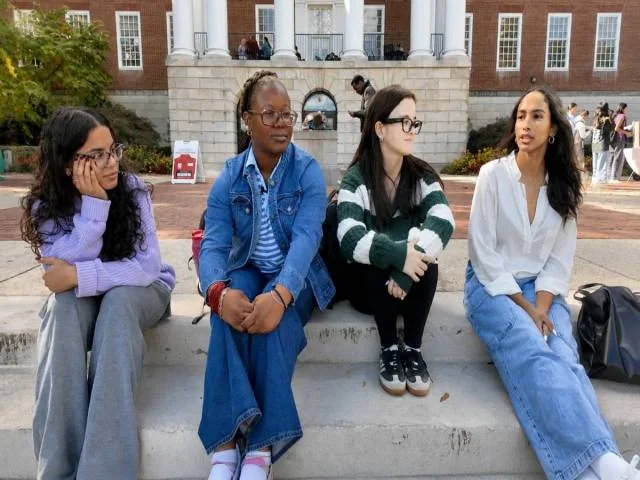
For the better part of the past year, I’ve been working as an executive producer on a series of short documentaries for the Greater Good Science Center called Connecting on Campus: Stories of Courage, Curiosity, and Empathy. The series features students at four universities across the country who are attempting to connect in some meaningful way with people who have different life experiences, political beliefs, or visions for the future.
At Iliff School of Theology, master’s and Ph.D. students imagine a version of the United States that embodies their values, and then they share those visions with one another. As they listen to one another’s values, they discover where they align, where they diverge, and where empathy can keep them in relationship with each other even when they disagree.
In a two-part story set at Bowie State University and the University of Maryland, students from both campuses gather at an event hosted by the schools’ Social Justice Alliance, a first-of-its-kind collaboration between an HBCU (historically Black college or university) and a PWI (predominantly white institution).
At Dickinson College, a deep friendship between the presidents of the Dickinson College Republicans and the Dickinson College Democrats creates the conditions for an unexpectedly collaborative relationship between the two clubs. Members of both clubs gather regularly and listen to each other’s thoughts about complex and often contentious political issues.
Back when we were in the middle of editing these episodes with our collaborators at Anaconda Street Productions, I spent an afternoon reviewing footage from one of the shoots, and then I took my dog for a walk. On the walk, I found myself repeating a line from an interview. It stuck! It’s been one of those smooth stones in my pocket ever since.
Of course, I’m not the only one who was changed by the experience of working on this series. To celebrate the release of Connecting on Campus, I invite you behind the scenes to meet my collaborators as we share some of the many things we learned as we helped tell these stories.
- Your voice matters and everyone has a part to play
It’s a pretty straightforward message, yet I hear it over and over in my head in the voice of Mrs. Dawn Collins. Your voice matters and everyone has a part to play. Mrs. Collins says these words during an interview in the first of our two episodes about Bowie State University (BSU) and the University of Maryland (UMD). Mrs. Collins and her husband, Mr. Richard Collins Jr., founded the BSU–UMD Social Justice Alliance after their son, Lt. Richard Collins III, a BSU student, was murdered on the UMD campus by a student in 2017. The Alliance brings together faculty, staff, and students to join the Collins’s commitment to “eradicating the ideology of intolerance, while confronting individuals and combatting systems that normalize indifference, justify injustice, perpetuate hate, and inflict violence.”
Mrs. Collins’s words have stuck with me, in part, because they insist on every person’s dignity, power, and responsibility. Our voices matter, and we all have a role to play in eradicating the ideology of intolerance and in combatting systems that perpetuate hate and inflict violence. That’s a strong call to action.
Mrs. Collins’s words have also stuck with me because they clearly articulate the heart of this documentary series. The students featured in this series offer us examples of what happens when people step into their power and accept the responsibility to understand themselves, understand each other (differences and all), and work together to build something new. That new thing could be a collaboration between clubs on campus or a vision for our future as a nation. Either way, these students know their voices matter and they have what it takes to practice doing this work together.
It was so helpful to have Mrs. Collins’s voice in my head, keeping me anchored in this truth as I worked. — Kelly Rafferty
- Small moments can lead to meaningful choices
When we first imagined Connecting on Campus, we wanted to find places where students were actually practicing the skills and qualities that make connection across differences possible, and to make those moments visible.
As I spent time with these students and their stories, and as we shaped the episodes in the edit, I found myself thinking more and more about choice. Across the series, you see students staying curious when they could shut down, listening to understand someone else’s experience, sharing their own perspective while making space for someone else’s, or finding the courage to remain in a difficult conversation.
In our Dickinson College episode, that choice shows up in a moment that could have easily passed. Ryan Thies recounts meeting Matthew Craig at a Halloween party during his freshman year. Matthew was dressed as Donald Trump. Ryan could have seen that costume, made an assumption about who Matthew was, and walked away. Instead, he leaned in and got to know him. An unlikely connection became a friendship, and eventually the two chose to become roommates. Ryan’s choice changed what became possible between them. That choice reflects the kind of empathy we talk about in our Bridging Differences work: the deliberate, and often difficult, choice to engage with someone else’s experience even when it feels unfamiliar or challenges our own worldview.
The choices look different in our Bowie State University and University of Maryland episodes—and the stakes are obviously very different, too. Here, the students and the Collins family are stepping into a history that is devastating: the murder of Lt. Richard Collins III on the University of Maryland campus and the work that emerged from it to confront hatred and bring students from the two campuses together.
Here, courage looks like choosing to show up and engage when discomfort, conflict, and fear might make it easier—and completely understandable—to withdraw. It’s the decision to say: This matters. I’ll attend. I’ll represent. I’ll listen. I’ll do my part.
Practices like “Listen with Empathy,” “Understand Their Values,” “Expand Your Views and Circles,” or “Perspective Giving and Getting” from our Bridging Differences in Higher Education Playbook can be learned.
But the choice to engage is one each of us has to make. My hope is that people watch these stories asking themselves, “What did that person do that made greater understanding possible, and where might I try that myself?” — Juliana Tafur
- Connecting with someone across a difference isn’t about erasing what separates us I came away thinking that “bridging” is sometimes misunderstood as compromise. Across all four videos, something more interesting emerges: You can build a relationship across a difference without necessarily resolving the difference itself.
At Iliff School of Theology, students imagine very different versions of America without being asked to arrive at one shared vision. At Dickinson, Republicans and Democrats engage seriously with each other without abandoning their political beliefs. And at Bowie State University and the University of Maryland, students move beyond assumptions, allow themselves to be vulnerable, ask difficult questions, and really listen to people whose backgrounds and experiences differ from their own. The circumstances are very different, but the lesson is consistent: Bridging isn’t about erasing what separates us. It’s about developing the curiosity, trust, and courage to stay connected across those differences.
The series asks a harder and more useful question than “How do we get everyone to agree?” It asks how we live, learn, and build community with people who may never see the world exactly as we do. The answers aren’t presented as a formula. You get to watch people experiment with listening, vulnerability, curiosity, disagreement, and repair, then decide for yourself what actually works. — Omar Lugones
- Disagreement can actually bring us closer together and create new opportunities
In my own experiences in smaller, more intimate classroom settings, I often observe an echo-chamber effect when opinions are shared, especially when the class is discussing a controversial topic. I have noticed a general apprehension about “going first” or initiating the conversation. Speaking for myself, I am often afraid of offering the “wrong” opinion, meaning a perspective that could be interpreted as supporting a politically or socially unacceptable position and cause my peers to view me as an outsider. I do not necessarily think my peers are experiencing the exact same thought process, but I sense that they are also self-conscious about expressing a conflicting opinion. As a result, people may default to agreeing with whoever offers an opinion first.
I thought it was remarkable that at Iliff School of Theology, Lindsay Ambler and Stephanie Nelson initially disagree with one another, and that moment opens space for others to enter the conversation and offer their own perspectives. By disagreeing respectfully, they demonstrate how disagreement can produce a deeper understanding of an issue than a conversation built only around agreement.
Lindsay takes a strong position on the effects of religion based on her past experiences with Christian institutions. By sharing an extremely vulnerable personal story, she creates the conditions for others to share their experiences and, in turn, promotes a greater sense of empathy within the conversation.
When Stephanie offers her own perspective on whether society can reach a state of perfection and equality, her response conflicts with Lindsay’s position. This point of contention could seemingly disrupt the vulnerable environment Lindsay has created, yet it does not. Instead, Lindsay responds to the challenge by deepening her explanation. In doing so, she creates new points of entry for others to join the conversation and contribute their own experiences.
At the end of the discussion, Stephanie expresses gratitude to those who shared their perspectives and revealed gaps in her own thinking. The conversation demonstrates how respectful disagreement can foster empathy, growth, and greater participation from every member of a group. — Tyler C. Tang
- Character development is often uncomfortable, but the payoff is worth it
Working on this series, I noticed the relationship between character and discomfort. Courage, empathy, humility, and curiosity all sound admirable in the abstract, but you really discover whether you possess them when another person challenges you. Character in these films often reveals itself in what someone does immediately after hearing something they don’t agree with.
For example, I identified with Josh Perez, a Ph.D. student and teaching assistant at Iliff School of Theology, in particular. I appreciate the way he draws on his own experiences as a second-generation Mexican American while recognizing that other people carry struggles he may never experience himself. His vision isn’t simply about creating a world that works better for people like him. It’s about making room for others to find liberation from their own struggles, as well. That ability to be grounded in your own experience while still making space for the experiences of others is at the heart of bridging differences. — Antonio Carrasco III
- Intellectual humility and curiosity pair well together; when in doubt, admit what you don’t know and let your curiosity guide you forward
If you’re exhausted by watching people argue about politics, identity, and social issues, watch people actually talk to each other instead. The series doesn’t suggest that differences disappear when people sit down together. It shows that disagreement can be productive when people approach each other with curiosity and humility.
Iliff School of Theology student Lindsay Ambler’s story affected me in a way I didn’t expect. It was hard to hear how painful some of her experiences within religious spaces had been. Learning how she was rejected after people discovered she was gay gave me a much deeper understanding of what she carried into the classroom. It reminded me how little we may know about someone until we give them the space to share their story.
Logan Midler from the University of Maryland stands out to me, too. I appreciate how honest she is about not having much interaction with people from different backgrounds and how easy it can be to start those conversations. Her desire to listen, learn, and become a better ally feels like a simple yet powerful example of bridging differences. — Ryan Carrasco
I hope there’s a moment in Connecting on Campus that sticks with you, too. Maybe that memorable line, that bit of dialogue, or that mindful pause will become a touchstone for your own experiments in bridging differences.
As another academic year begins, may the stories in this series also serve as an example of what students are capable of doing when they’re given the space and support to practice connecting with one another. Campuses across the country are facing real challenges—everything from threats of censorship to rising costs and cuts to funding—and these opportunities to practice bridging differences must not be sacrificed along the way. They’re too important to our individual and collective well-being.
Watch Connecting on Campus: Stories of Courage, Curiosity, and Empathy.