

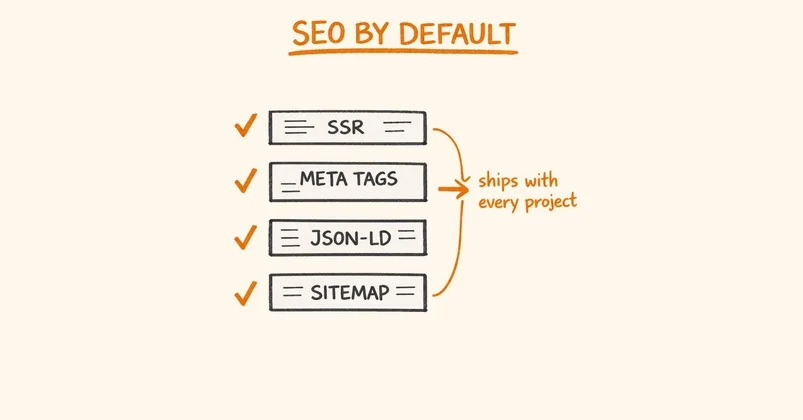
I don't offer SEO as a service. But every site I build ships with technical SEO baked in — because it's not marketing, it's engineering. A site that search engines can't crawl or understand is a site that doesn't work properly. In the pikkuna.fi e-commerce build , that meant correct hreflang across 30 languages, server-rendered product pages, and JSON-LD that survived localization. Same principles, scaled up. slug="mvp-development" text="Building a Next.js project that needs to rank from day one? SSR, structured data, and sitemaps are part of what I ship — not add-ons." /> Server-Side Rendering by Default Single-page apps with client-side rendering are invisible to most crawlers. Every project I build uses Next.js App Router with server components: // app/products/[slug]/page.tsx export default async function ProductPage ({ params }: { params : Promise < { slug : string } > }) { const { slug } = await params ; const product = await getProduct ( slug ); return ( < article > < h1 > { product . name } < /h1 > < p > { product . description } < /p > < /article > ); } The HTML arrives fully rendered. No JavaScript required for indexing. Dynamic Meta Tags Every page gets proper meta tags generated from actual content: // app/products/[slug]/page.tsx export async function generateMetadata ({ params , }: { params : Promise < { slug : string } > ; }): Promise < Metadata > { const { slug } = await params ; const product = await getProduct ( slug ); return { title : ${ product . name } | Store , description : product . description . slice ( 0 , 160 ), openGraph : { title : product . name , description : product . description , images : [ product . image ], }, }; } This handles SEO meta tags, Open Graph for social sharing, and Twitter cards — all from one function. JSON-LD Structured Data Schema.org markup tells search engines exactly what the content represents: function ProductJsonLd ({ product }: { product : Product }) { const schema = { " @context " : " https://schema.org " , " @type " : " Product " , name : product . name , description : product . description , image : product . image , offers : { " @type " : " Offer " , price : product . price , priceCurrency : " EUR " , availability : " https://schema.org/InStock " , }, }; return ( < script type = " application/ld+json " dangerouslySetInnerHTML = {{ __html : JSON . stringify ( schema ) }} / > ); } I add appropriate schemas based on content type: Product , Article , Organization , FAQPage , BreadcrumbList . Automatic Sitemap Generation Next.js can generate sitemaps from your data: // app/sitemap.ts export default async function sitemap (): Promise < MetadataRoute . Sitemap > { const products = await getAllProducts (); return [ { url : " https://example.com " , lastModified : new Date () }, ... products . map (( p ) => ({ url : https://example.com/products/ ${ p . slug } , lastModified : p . updatedAt , })), ]; } No plugins, no external services. Just code that generates /sitemap.xml at build time. This isn't optimization work you hire someone for later. It's the baseline for a properly built website. When I deliver a project, the technical SEO foundation is already there — because skipping it means shipping broken software. If you want to go further with the indexing layer, read IndexNow in Next.js: Instant Indexing After Every Deploy and llms.txt for AI Discoverability . Together with the patterns above, that's the full stack. slug="seo-audit" text="Want this same checklist applied to your existing site? Fixed-fee Technical SEO Audit — keyword research per market, schema, sitemap, hreflang, Core Web Vitals, indexing, broken links, OG images — delivered as a prioritised written report in 5 working days." /> For MVP development with this foundation built in from the start — get in touch .
Technical SEO for Next.js: SSR, JSON-LD, and Sitemaps
Iurii Rogulia
Tags