AGU Blogosphere

In this final installment of AGU’s blog series on the House Appropriations Committee’s spending bills for fiscal year 2027 (FY27), we cover the Department of Energy’s (DOE) Office of Science and the National Institute of Environmental Health Sciences (NIEHS)—two agencies whose funding is spread across three separate appropriations bills and whose work underpins environmental research, public heal…
As the House Appropriations Committee works through its spending bills for fiscal year 2027 (FY27), the stakes for science remain high. This month, the committee advanced its Interior, Environment, and Related Agencies (I&E) bill, recommending funding for the U.S. Geological Survey (USGS) that pushes back sharply against the administration’s proposed cuts, while recommending significant reduction…
Bursting the Academic Bubble: Why Scientists Must Bridge the Gap Between Research and Policy Jelis J. Sostre Cortés, AGU-sponsored CASE workshop participant and PhD candidate at the Georgia Institute of Technology As someone who was born and raised in Puerto Rico, I have been exposed to countless natural hazards. I have witnessed firsthand how a disconnect between scientists and policymakers can …
The Office of Management and Budget has proposed sweeping revisions to the regulations that govern all federal grants, cooperative agreements, and other forms of federal financial assistance. Source
By Dr. Jean Pierre Ometto, International Secretary, AGU Board of Directors On Thursday 16 April and Friday 17 April, the AGU Board of Directors gathered for its April meeting in Hoboken, New Jersey at the headquarters of our publishing partner, Wiley. The AGU Board meets with Wiley global leadership every other year to talk about the future of publishing and building our partnership. I was gi…
On 28 May 2026, AGU sent a letter to House leadership endorsing the NOAA Global Ocean Monitoring and Observing Research Act. America’s ability to forecast severe weather, prepare for coastal hazards, and understand longterm climate trends depends on consistent, high-quality ocean data. Without sustained global observation systems, these capabilities erode, leaving communities, emergency managers…
On 28 May 2026, AGU sent letters to leadership in congress endorsing the Weather Research and Forecasting Innovation Reauthorization Act of 2026. The bill’s goal of building on the achievements of the original Weather Act, which drove significant advances in forecasting and the prediction of high-impact weather events, is critical to strengthening national forecasting capabilities. As communities…
On 28 May 2026, AGU sent letters to Representative Tonko and Senator Schatz endorsing the Scientific Integrity Act. Now more than ever, it is critical to bolster public trust in science by ensuring that federal science is impartial, evidence-based, and conducted in the public interest. We applaud this bill’s effort to strengthen, expand, and standardize existing federal agency scientific integri…
On 14 May 2026, AGU joined a letter with the Coalition for National Science Funding. (CNSF) to urge the HELP Committee to schedule a confirmation hearing for James O’Neill, the President’s nominee to serve as Director of the National Science Foundation (NSF). The NSF Director sets the scientific and strategic priorities of the agency, represents NSF before Congress and the scientific community, a…
On 12 May, AGU joined several organizations to request support for robust funding for the Department of Energy’s (DOE) research, development, and demonstration (RD&D) programs in the Energy and Water Development and Related Agencies Appropriations Act, 2027 (FY27). Our nation cannot afford to be dependent on adversarial countries for critical energy technologies and supply chains, leaving America…

On 12 May 2026, AGU joined various organizations representing the full breadth of America’s scientific, technological, engineering, and mathematics (STEM) research, to urge Congress to fully support and fund the National Science Foundation (NSF) at the highest levels possible in the Fiscal Year 2027 budgetary process. A serious concern that has arisen is the Administration’s proposal to eliminate…
Congress has taken its first formal step in pushing back against the Administration’s proposed cuts to science funding for fiscal year 2027 (FY27). The House Appropriations Committee’s FY27 Commerce, Justice, Science, and Related Agencies (CJS) bill, released this month, recommends funding for NASA, NOAA, and NSF that rejects some of the most damaging elements of the President’s budget request—pr…
The Energy Sciences Coalition (ESC) urges Congress to reject the proposed cut to the U.S. Department of Energy (DOE) Office of Science in the FY 2027 budget request. Instead, Congress should appropriate $9.5 billion in FY 2027 to maintain U.S. competitiveness and unleash innovation in new energy and emerging technologies, consistent with ESC’s February 2026 FY 2027 funding statement. Read the f…
On 30 March 2026, AGU joined a public comment submitted by the National Council of Nonprofits urging the General Services Administration to withdraw its proposal to revise the Financial Assistance General Certifications and Representations required for System for Award Management registration. Read the full comment here. Source
On 17 April, AGU alongside 7 other NASA Science Mission Directorate (SMD) stakeholders sent a letter urging Congress to appropriate $9 billon in fiscal year 2027 for NASA SMD. On behalf of the undersigned professional societies and organizations representing tens of thousands of scientists, researchers, students, and enthusiasts across all 50 states, we urge Congress to appropriate $9 billion for…
NASA’s Science Mission Directorate (SMD) has enabled American leadership in the Earth and space sciences for decades. Through NASA SMD, American researchers have revolutionized humanity’s fundamental understanding of the universe, provided data essential to national security and weather forecasting, and spurred commercial development. The pace of global investment in space science is accelerating…
Last Friday, President Trump released the fiscal year 2027 President’s Budget Request. What we are seeing is devastating, and it demands a forceful response. As our policy team details on The Bridge, this budget is largely a repeat of last year’s proposal, but repetition does not soften the blow. NASA’s Science Mission Directorate is cut by nearly half its budget. The National Science Foundation…
April 6, 2026 On Friday, 3 April, the fiscal year 2027 (FY27) President’s budget request (PBR) was released. Based on the details released, the request is largely a repeat of the president’s FY26 budget, as expected. The Administration has now had a year to appoint its political leaders and review agencies’ actions, so we also expect to see more robust plans to implement their priorities. For exa…
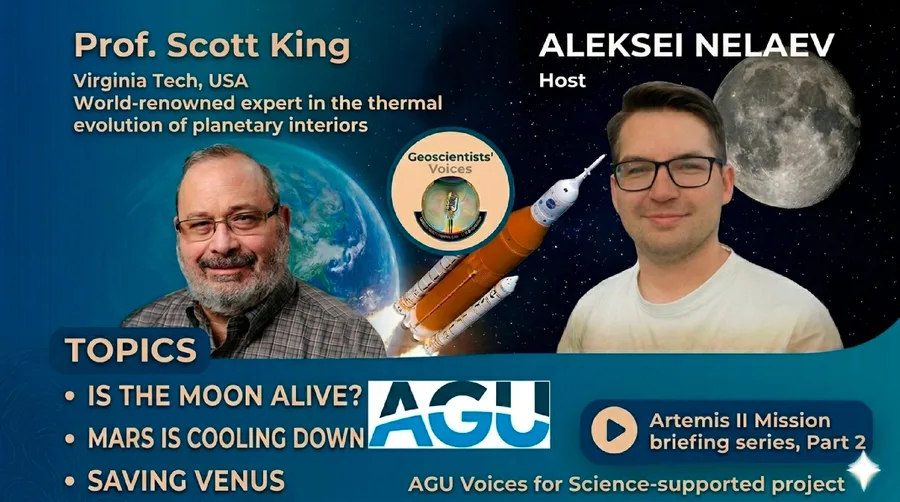
March 30, 2026 Aleksei Nelaev, AGU Voices for Science cohort member With the Artemis II launch scheduled for April 1, the world’s attention is fixed on the sky. But for geoscientists, the mission isn’t just about the rocket – it’s about the “geological proving ground” that awaits us in lunar orbit. As a member of the AGU Voices for Science program, I’ve seen firsthand how critical it is for scien…
research.ioSign up to keep scrolling
Create your feed subscriptions, save articles, keep scrolling.