When making a high-frequency or mid-frequency prediction on an assets return, what are the advantages and disadvantages of making a continuous prediction vs a prediction that only fires on a particular event? For example my model might have a number of features: order imbalance, trade imbalance etc Do I want to make a continuous prediction of where the asset price is going? Or do I want to make p…
I have been writing here about one core idea: AI agents do not only fail because they forget things. They fail when the things they know, the things they are allowed to do, the thing they are for, and the thing they actually do stop agreeing with each other. I have been calling that cross-layer coherence. For a while, that lived in research. Claims. Frozen rules. Pre-registrations. Receipts. Clea…
I build algorithmic trading bots as a side project. Nothing fancy — just small strategies that trade US equity options automatically. The problem I kept running into wasn't the strategy logic. It was the data. Every time I wanted to pull real-time options chains, Greeks, or IV, I had two options: Pay $99+/mo to a data provider Scrape something I probably shouldn't be scraping Neither felt right f…
"AI picked these stocks" is one of the most repeated claims on FinTwit right now. Almost none of it is reproducible. Screenshot of a ChatGPT chat. No data source. No filters. No way to check if the tickers even exist. If you're: building AI agents that touch market data, evaluating whether LLMs can actually reason over financial datasets, or just tired of "AI stock picker" threads with zero code …
The Quest Begins (The "Why") Honestly, I was tired of staring at charts at 2 a.m., trying to catch that perfect entry while my coffee went cold. I’d set a manual alert, jump onto the exchange, click “buy”, and then second‑guess myself as the price slipped away. It felt like I was playing a never‑ending game of Whac‑A‑Mole, and I kept losing the mole. One night, after yet another missed opportunit…
Let's say you decide to buy a 2Y10Y ATM swaption straddle (i.e. buy 10 million ATM payer swaption and buy 10 million ATM receiver swaption).
In order to delta hedge, I believe you would short the 2Y10Y forward swap. My questions are: How exactly does this delta hedging work? When do you profit from it (is it when there is a big move in realized volatility in the underlying forward swap)? What nee…
A comprehensive theoretical and computational analysis of the early exercise decision for rational investors. Explores Black's approximation, Monte Carlo simulation, and the Longstaff-Schwartz method for determining optimal exercise strategies.
📊 Deep Research • 📈 Options Strategy
Topics: quantitative finance, investment analysis, financial education, options trading, derivatives
The Quest Begins (The "Why") Picture this: I’m sitting at my desk, coffee gone cold, staring at a spreadsheet that looks like something out of Indiana Jones and the Last Crusade – a maze of dates, prices, and a gut feeling that I’ve cracked the code to beat the market. I had a shiny new idea: buy when the 50‑day moving average crosses above the 200‑day (the classic “golden cross”) and sell when i…
This study investigates short-term price reversals—temporary retracements following adverse daily returns—and develops a systematic trading framework to capture this effect across multiple asset classes. Using daily data from six liquid ETFs spanning equities, fixed income, currencies, gold, and commodities over the period 2006–2025, the strategy applies a long-term trend filter based on a 200-da…
Negative Risk (NegRisk) is one of the most powerful innovations on Polymarket for builders of sophisticated Polymarket trading bots . It dramatically improves capital efficiency in multi-outcome “winner-take-all” events by mathematically linking all related conditional tokens. Why Negative Risk Matters In standard multi-outcome markets, positions are completely independent. Betting against one ca…
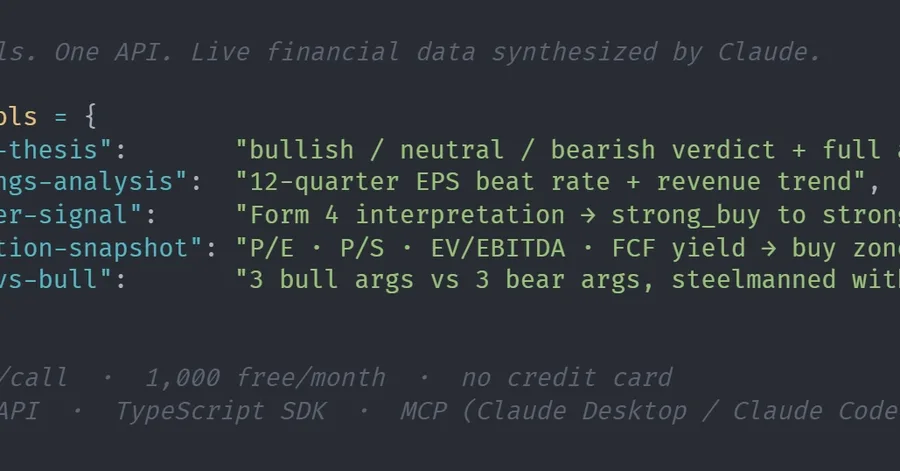
I was building a feature that needed to say something useful about a stock — not just print its P/E, but actually read the situation: is this cheap or expensive, what's the bull case, is the insider buying real or routine. I went looking for an API. Every finance API I found sold me raw data . Alpha Vantage, Twelve Data, Yahoo Finance, FMP — they'll hand you fundamentals, prices, filings, all of …
So, I'm using MetaTrader5 to get data and form a Binary Options bot, but to backtest I've just been keeping track (within my EA code) virtual binary Up/Down orders paired with expiry and bet amount. And if it turns out to be a winner, then incrementing a counter. Then periodically displaying win rate on chart. However, to be sure I'm not deluding myself into thinking I've got a winning EA for b…
Scientific Reports, Published online: 18 June 2026; doi:10.1038/s41598-026-58302-7 Financial time series forecasting with a hybrid VMD–CSA–BiT framework
A crash course on the theory underpinning Monte Carlo methods along with a brief survey of their practical applications in the realm of Quantitative Finance.
I Built an AI-Native Trading Engine in Python. 5 Months Later, Here's What Changed 9 strategies → 12. ML scoring, backtesting, partial take-profit, Telegram bot that survived a 3-echelon audit. Open source, MIT, trading real money. Why I Built This (And Kept Building) Trading bots come in two flavors: black-box SaaS at $50/month, or GitHub scripts that crash at 3 AM. I wanted neither. Five months…
This video decomposes the deep research article on strategy decay and Minimum Regime Performance (MRP) — breaking down how systematic strategies deteriorate across hostile macro regimes and the quantitative frameworks for building regime-aware portfolios that survive structural drawdowns.
🎥 Video Tutorial
🎥 Watch Video: https://youtu.be/oD_Ki-sDNzM
Topics: quantitative finance, investment anal…
The Quest Begins (The "Why") Picture this: I’m hunched over three monitors at 2 a.m., coffee gone cold, staring at a chart that looks like a glitchy 8‑bit version of Tron . My brand‑new trading bot just placed a market order for 10 000 BTC … at $0.01. Yep, you read that right. My heart did a little Star Wars “Imperial March” as the exchange’s risk engine slammed the brakes, and I spent the next h…
In my core article Building a Polymarket Trading Bot Architecture: Key Technical Decisions , I showed how to build a modular bot with clean lifecycle, risk engine, and pluggable strategy brains. This post covers one of the most commonly observed strategies among profitable 5-minute bots: the Fair Value Sweep — a pure taker approach that hunts stale asks using real-time CEX fair value. Strategy Co…
How I built a real-time automated trading system that monitors BTC, ETH, SOL, and XRP prediction markets and executes trades based on short-lived pricing inefficiencies. Most people think of Polymarket as a prediction market for elections, sports, and current events. As a developer, I saw something else. I saw a real-time marketplace with public APIs, continuously updating order books, frequent s…
algorithmic-tradingquant-finance
research.io
Sign up to keep scrolling
Create your feed subscriptions, save articles, keep scrolling.











 research.io