Nature Communications, Published online: 20 June 2026; doi:10.1038/s41467-026-74648-y Replicating the brain’s multisensory integration is vital for artificial intelligences. Liu et al. have developed biomimetic ferroelectric-semiconductor field-effect transistors to mimick the brain’s audiovisual integration driven by hardware-native multi-physics coupling.
Imagine wearing a lightweight patch that can monitor your heartbeat, breathing and movements for long periods without ever needing a battery. Or imagine robots with soft, flexible skins that can feel pressure and movement much like human skin. These ideas may be closer to becoming reality thanks to a new self-powered sensor developed by researchers […] The post Scientists create a self-powered se…
Researchers at the Medical University of Vienna, in collaboration with ETH Zurich, the Technical University of Munich and Medical Faculty Belgrade, have developed a wearable neurorobotic system that combines electrical neurostimulation with hand exoskeletons.
Imagine a surgeon being able to “step inside” a digital version of a patient’s body — studying organs, tissues, and complex structures, rehearsing procedures, and evaluating possible approaches before performing the actual operation. The integration of robotic surgical assistants (RSAs) in operating rooms offers substantial advantages for both surgeons and patient outcomes. Currently operated thr…
The Expedition 74 crew explored how weightlessness affects cartilage growth and the digestive system on Thursday to protect crew health and improve patient care on Earth. The orbital residents are also gearing up for a robotics maintenance spacewalk at the end of the month on the International Space Station. The post Advanced Tech on Station Informing Space-Designed Health Treatments appeared fir…
Autofluorescence (AF) imaging enables label-free visualization of tissue metabolism and microenvironmental alterations, while deep learning (DL) provides powerful tools to decode its complex optical signatures. Their integration has emerged as a promising framework for functional and biologically informed disease assessment. Recent studies demonstrate that AF-DL approaches improve lesion detectio…
Biomedical tests using augmented and virtual reality tools to advance space health dominated the research schedule aboard the International Space Station on Wednesday. The Expedition 74 crew is also turning its attention to a spacewalk at the end of the month following the departure of a U.S. cargo spacecraft. The post Advanced Health Research on Station Using Augmented, Virtual Reality Tools app…
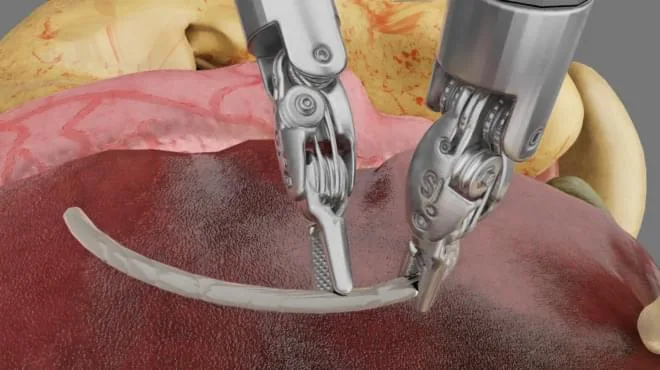
RAMRS consists of two modules. The first, robot‑assisted osteotomy, uses an optical tracking system and a collaborative robotic arm to guide the bone saw. A hand‑eye calibration procedure determines the exact pose of the robot's end‑effector relative to a tracking marker.
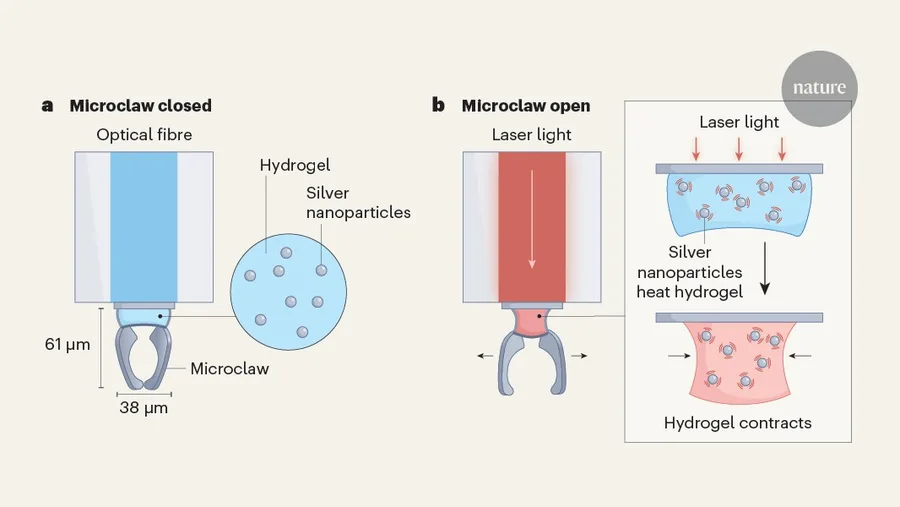
Nature, Published online: 17 June 2026; doi:10.1038/d41586-026-01703-5 A microscale gripper that can be opened and closed using light can fit into tight spaces and perform tasks linked to clinical applications.
Nature, Published online: 17 June 2026; doi:10.1038/s41586-026-10673-7 A miniature three-dimensional optical fibre gripper enables powerful, precise micromanipulation of particles and single cells in confined spaces, bridging the gap between optical and mechanical tweezers.
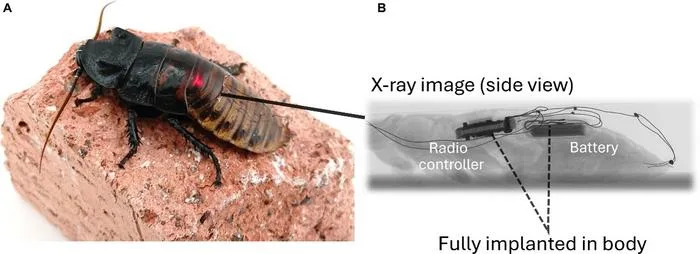
The gap was eight millimetres. The cockroach was taller than that, and it knew it, in whatever way a cockroach knows things. It lowered its head, swept its antennae across the underside of the shutter blocking the corridor, and shoved. The shutter lifted. The insect was through in a little under ten seconds, the same as any of its untouched cage-mates. The difference was that this one had a radio…
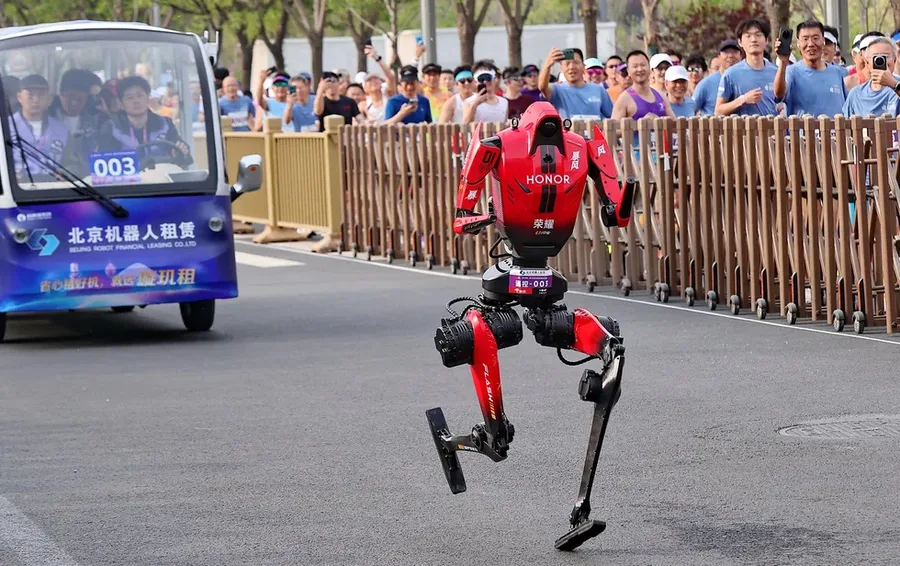
On April 19, 2026, the Honor Lightning humanoid robot ran a half-marathon in 50 minutes and 26 seconds , beating the human world record by 7 minutes and the best robot time from 2025 by almost two hours. How did they do it? Is there some magical technology or technique that unlocked this performance? How did they beat the significantly better-known Unitree (who reportedly had to supply an ice bac…
Wearable exoskeletons can help reduce physical strain in the workplace and protect employees from injury, but the technology has yet to achieve widespread adoption. A new study published in PLOS One by engineers at The University of Texas at El Paso may explain why: The technology is still too complex and cumbersome for everyday use.
We’ve all been there: it’s 2 AM, you’re deep in a "Refactoring Rabbit Hole," your coffee is cold, and your heart is racing. You feel productive, but is your body paying the price? As developers, we often ignore the physical signals of burnout until it's too late. In this tutorial, we are going to quantify the "Dev Grind." We'll build a Programmer Stress Warning Dashboard using the Oura Ring API t…
A tiny electronic sensor that can be swallowed like a pill may soon provide one of the most accurate ways to measure body temperature. Engineers at the Massachusetts Institute of Technology (MIT) have developed a miniature device that continuously monitors temperature from inside the digestive tract, potentially helping doctors detect infections earlier and better manage […] The post Swallowable …
biomedical-engineeringengineering
research.io
Sign up to keep scrolling
Create your feed subscriptions, save articles, keep scrolling.















 research.io