computer-architecture


Franklin “Frank” Kuo Codeveloper of ALOHAnet Fellow, 91; died 14 April Kuo helped develop ALOHAnet , a pioneering computer system at the University of Hawaii at Mānoa , in Honolulu. The system went online in 1971 and represented the first public demonstration of a wireless packet data network . It was an inspiration for Robert Metcalfe ’s development of Ethernet a couple of years later. In 2020 A…
Design and implement FPGA-based solutions for high-performance hardware platforms used in cybersecurity, data centres, and advanced computing. Work across the full development lifecycle from prototyping to production, developing RTL, building communication interfaces, and supporting system validation in collaboration w...
A 3D CAD application usually contains several layers that solve very different problems. The user interface manages commands and interaction, the document model stores engineering intent, visualization turns model data into something that can be displayed, and import or export components communicate with external formats. Between these systems sits the geometry layer: the part responsible for rep…
In the book "Operating System Concepts", CPU is defined as hardware that executes instructions and Processor is defined as physical chip and Core is defined as basic computational unit of ...

Why should you care? If you've ever bought a laptop or smartphone, you've probably seen specifications like: 8 GB RAM 512 GB SSD 1 TB Storage Many beginners assume RAM and storage are the same thing because both are measured in gigabytes. They are not. Understanding the difference between RAM and storage helps you: Choose the right computer for your needs. Understand why applications become slow.…
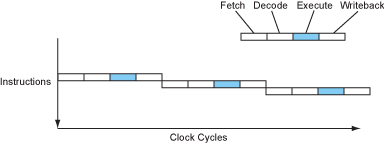
Central Processing Unit (CPU) This is a general-purpose computer. It fetches an instruction, say “add 2”, from memory, applies that instruction to data, say “2”, then commits the result, “4”. Modern phone CPUs overlap these steps, allowing a single core to complete tens of billions of instructions per second. They contain six to eight cores, some high-performance and other smaller, power-efficien…

The Challenge of Combinatorial Complexity Large-scale combinatorial optimization problems—such as the classic Traveling Salesperson Problem (TSPLIB)—exhibit an exponential growth in the search space as the number of nodes increases. Traditional CPU-based approaches frequently run into parallelism limitations and bus latency bottlenecks when trying to explore multiple routes or states simultaneous…

Computer Science > Hardware Architecture Title:Characterizing Warp Divergence from Pascal to Blackwell View PDF HTML (experimental)Abstract:Since Volta introduced Independent Thread Scheduling (ITS), NVIDIA GPUs have been widely assumed to handle warp divergence in a fixed manner. We test this assumption across Ampere, Hopper, and datacenter and consumer Blackwell GPUs, using pre-ITS Pascal as a …

Global Navigation Satellite System (GNSS) spoofing--the transmission of counterfeit signals that trick receivers into reporting false positions or times--poses a growing threat to aviation, maritime shipping, power grids and autonomous systems. While machine learning has improved detection, most models fail when confronted with attack scenarios they have never seen before, because they learn data…
1. The Core Problem - Why Virtual Memory Exists Without virtual memory, every program would directly address physical RAM. This creates three fundamental problems: No isolation: process A could read or overwrite process B's memory. One buggy program could corrupt another or the OS itself. No abstraction: programs would need to know exactly where in physical RAM they're loaded. The same binary cou…
Every engineering student graduates with a transcript. The challenge is convincing an employer you're more than a GPA. In a job market where hiring managers are hunting for candidates who can solve problems on day one, practical experience has become more important than ever. Companies seek engineers who have tackled real problems, debugged real systems and built something that works outside the …

NUMA - Part 1: Cores, memory, and the distance between them Two virtual machines on the same host, configured identically, running the same workload. One of them is 20% slower than the other, consistently. Nothing is wrong with the workload, nothing is wrong with the host, no contention from other tenants. The slow one's memory just happens to be on the wrong side of an interconnect from the CPUs…
nvidia-peermem "Invalid argument" on Ubuntu — Fix GPUDirect RDMA with DMA-BUF TL;DR: If modprobe nvidia-peermem fails with Invalid argument ( -EINVAL ) on a system using the inbox Ubuntu InfiniBand stack ( rdma-core ), the module is not broken and you do not need it. nvidia-peermem requires an API that only exists in MLNX_OFED. On Hopper/Blackwell GPUs with the NVIDIA open driver, use DMA-BUF ins…

I bought a cute little 4 bit cpu kit from Aliexpress called the TD4. It has 2 registers, some LEDs, and 16 bytes of program ROM. Quite limited but still very cool and teaches a lot of principles of computer architecture. The documentation, schematics, and pictures for this cpu are here https://github.com/wuxx/TD4-4BIT-CPU. It’s a little sparse though. I can imagine a student getting overwhelmed. …
research.ioSign up to keep scrolling
Create your feed subscriptions, save articles, keep scrolling.