
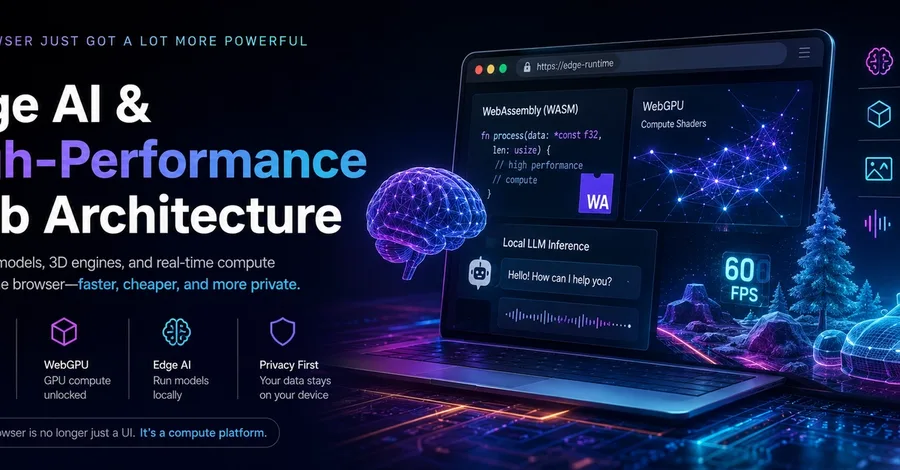

The Browser Is Becoming a Compute Platform: How Edge AI and High-Performance Web Architectures Are Reshaping the Modern Web For most of the web's history, browsers were presentation layers. They rendered HTML, executed lightweight JavaScript, and delegated computationally expensive tasks to backend infrastructure. That assumption is rapidly becoming obsolete. Modern web applications now perform workloads that would have been considered impossible inside a browser only a few years ago: Local LLM inference Real-time image and video processing CAD and design tooling Digital twins and 3D visualization Spatial computing applications AI-powered assistants High-density data visualization The browser is no longer just a UI layer. It is becoming a high-performance execution environment capable of leveraging CPU cores , GPU accelerators , shared memory , and near-native runtime performance. This architectural shift is being driven by three technologies: WebAssembly (WASM) WebGPU Edge AI runtimes Together, they are fundamentally changing how engineers design scalable applications. The Problem With Traditional Cloud-Centric Architectures For years, web applications followed a simple pattern: User Action ↓ Frontend ↓ API Request ↓ Backend Compute ↓ Database ↓ Response Every expensive operation happened on the server. Whether processing images, running machine learning models, generating recommendations, or rendering complex visualizations, the browser acted primarily as a transport layer. This model worked well until applications became increasingly compute-intensive. As AI adoption accelerated, engineering teams began encountering several architectural bottlenecks. Infrastructure Cost Explosion Modern inference workloads are expensive. Every user interaction can consume: GPU cycles CPU resources Memory allocation Network bandwidth At scale, cloud costs often grow linearly with usage. A successful product can become a victim of its own growth as GPU inference bills continue rising. Latency Constraints Every request introduces unavoidable delays: Browser ↓ Internet ↓ Backend ↓ Model Inference ↓ Internet ↓ Browser Even highly optimized systems accumulate latency through network traversal and server processing. For real-time experiences, these delays become increasingly noticeable. Privacy Requirements Many modern applications process: Personal documents Images Audio recordings Medical information Enterprise data Transmitting this information to cloud infrastructure introduces compliance, security, and privacy concerns. Offline Limitations Traditional architectures depend entirely on connectivity. When the network disappears, functionality disappears. The Edge Runtime Shift To address these challenges, engineering teams are increasingly moving compute workloads away from centralized infrastructure and directly onto client devices. The browser runtime is becoming the new execution layer. +-------------------------------------------------------------------------+ | BROWSER EDGE RUNTIME | | | | +--------------------+ Shared Memory +-----------------------+ | | | WebAssembly (WASM) | <-----------------> | WebGPU / WGSL | | | | (Near-Native CPU) | (SharedArrayBuffer) | (Parallel Computing) | | | +--------------------+ +-----------------------+ | | ^ ^ | | | Zero-Copy Direct | | | v Interoperability | | +-------------------------------------------------------------------+ | | | Main Thread / DOM Execution Layer | | | +-------------------------------------------------------------------+ | +-------------------------------------------------------------------------+ Instead of sending every operation to a backend service, applications increasingly execute workloads locally using the user's CPU and GPU resources. This architectural model is commonly referred to as Edge AI or Client-Side Compute. Why Traditional Browser Architectures Hit a Wall Moving compute into the browser sounds attractive. In practice, it introduces significant engineering challenges. 1. The Single-Threaded Event Loop JavaScript executes primarily on a single main thread. When expensive operations run directly inside the event loop: Rendering stalls Input responsiveness degrades Frame rates collapse Tasks such as matrix multiplication, image transformations, graph traversal, or machine learning inference can easily block rendering pipelines. The result is UI jank and poor user experience. 2. Garbage Collection Pauses JavaScript's memory model is convenient but not free. Applications that continuously allocate and destroy large numbers of temporary objects trigger garbage collection cycles. In high-performance environments targeting: 60 FPS = 16.6ms/frame 120 FPS = 8.3ms/frame Even a single GC pause can cause visible frame drops. For applications handling real-time rendering or inference, these interruptions become significant bottlenecks. 3. WebGL Performance Limitations For years, WebGL powered advanced browser graphics. While revolutionary at the time, it suffers from several architectural limitations: High CPU driver overhead Legacy OpenGL-inspired design Limited compute capabilities State-machine complexity Difficult resource management Most importantly, WebGL was built primarily for graphics rendering rather than general-purpose parallel computation. Modern AI workloads require something fundamentally different. The Modern Edge Technology Stack To overcome these limitations, browser platforms now combine three foundational technologies. Pillar Technology Purpose Compute Core WebAssembly (WASM) Near-native CPU execution GPU Compute WebGPU Modern hardware acceleration AI Runtime ONNX Runtime Web / Transformers.js Browser-based model execution Together they transform the browser into a legitimate compute platform. WebAssembly: Bringing Native Performance to the Browser WebAssembly allows developers to compile languages such as: Rust C++ Go C# into a compact binary format executed directly by browser engines. Unlike traditional JavaScript execution: No garbage collection overhead Predictable memory layout Better CPU utilization Near-native execution speed Compute-intensive workloads can now execute inside dedicated Web Workers rather than blocking the main thread. For many workloads, WebAssembly achieves approximately 90–95% of native performance while maintaining browser portability. This makes it ideal for: AI inference Image processing Video encoding Physics simulations Scientific computing WebGPU: Unlocking Modern GPU Hardware If WebAssembly solved CPU limitations, WebGPU solves GPU limitations. WebGPU is a next-generation graphics and compute API designed around modern hardware standards such as: Vulkan Metal Direct3D 12 Unlike WebGL, WebGPU exposes true compute capabilities. This enables browsers to execute: Neural network inference Matrix multiplication Physics simulations Parallel data processing Advanced rendering pipelines through compute shaders written in WGSL. The significance cannot be overstated. For the first time, browser applications can leverage GPU hardware similarly to native desktop applications. Edge AI in Practice The emergence of WebGPU has accelerated browser-based AI dramatically. Frameworks such as: ONNX Runtime Web Transformers.js WebLLM allow machine learning models to execute entirely within browser environments. A typical architecture looks like: Browser ↓ Model Loading ↓ WASM Runtime ↓ WebGPU Compute ↓ Local Inference Modern optimizations such as: INT8 quantization Weight compression Model sharding enable useful AI models to run with surprisingly small memory footprints. Instead of calling cloud APIs, applications can increasingly perform inference locally. Critical Engineering Pattern #1: Zero-Copy Data Pipelines One of the biggest hidden performance killers in browser compute workloads is memory copying. Large datasets often travel through multiple layers: File Input ↓ JavaScript Memory ↓ Worker Memory ↓ WASM Memory ↓ GPU Memory Every transfer introduces overhead. Modern architectures increasingly rely on SharedArrayBuffer to eliminate unnecessary duplication. const MEMORY_PAGES = 100 ; const sharedBuffer = new SharedArrayBuffer ( MEMORY_PAGES * 64 * 1024 ); const float32View = new Float32Array ( sharedBuffer ); wasmModule . process_matrix_pipeline ( float32View . byteOffset , float32View . length ); This pattern enables JavaScript, Web Workers, and WebAssembly modules to operate on the same memory region without serialization costs. For large-scale image processing and AI pipelines, the performance gains are substantial. Critical Engineering Pattern #2: Explicit GPU Memory Management One misconception among frontend engineers is that browser garbage collection manages everything. GPU resources are different. Objects such as: Geometries Textures Render targets Materials remain allocated until explicitly released. Failure to dispose resources leads to: VRAM growth Memory fragmentation Rendering slowdowns Browser crashes A common Three.js cleanup pattern looks like: function disposeThreeJSObject ( node ) { if ( ! node ) return ; if ( node . geometry ) { node . geometry . dispose (); } if ( node . material ) { if ( Array . isArray ( node . material )) { node . material . forEach ( mat => disposeMaterial ( mat )); } else { disposeMaterial ( node . material ); } } } As browser-based 3D applications grow more sophisticated, explicit GPU lifecycle management becomes increasingly important. The Business Impact This shift isn't happening purely because engineers enjoy new technology. It solves real business problems. Lower Infrastructure Costs Every inference executed locally is one less inference executed on cloud GPUs. Many AI-powered products can dramatically reduce backend compute costs by moving workloads to client devices. Better User Experience Local execution removes network round trips. Responses become effectively instantaneous. Privacy-First Design Sensitive information remains on-device. Documents, images, and audio files never leave the user's browser. Offline Functionality Applications continue working without connectivity. This dramatically improves resilience. Infinite Horizontal Scaling Traditional systems scale through infrastructure expansion. Edge architectures scale through user hardware. Old Model: 1 Datacenter ↓ 1 Million Users
New Model: 1 Million Devices ↓ 1 Million Compute Nodes Every user's device contributes processing power. The Future of High-Performance Web Architecture The most important change happening in web engineering today isn't a new framework. It's a change in architectural assumptions. For decades, browsers were considered thin clients. Today they are evolving into distributed compute environments capable of executing AI models, rendering complex 3D worlds, processing multimedia streams, and performing large-scale parallel computation. The modern architecture is no longer: Browser → Server → Result It is increasingly becoming: Browser → Compute → Result WebAssembly brings near-native execution. WebGPU brings modern hardware acceleration. Edge AI brings intelligent local inference. Together, they represent a fundamental shift in how applications are built, scaled, and optimized. The browser is no longer just where users interact with software. It's becoming where the software runs.