Nature Communications, Published online: 29 July 2026; doi:10.1038/s41467-026-75464-0 The authors demonstrate second- and third-harmonic generation of spatiotemporal optical vortices (STOVs) with topological charges up to 40 at the fundamental frequency, in cascaded crystals. The conservation law of transverse optical angular momentum is established for sum-frequency generation, providing a route…
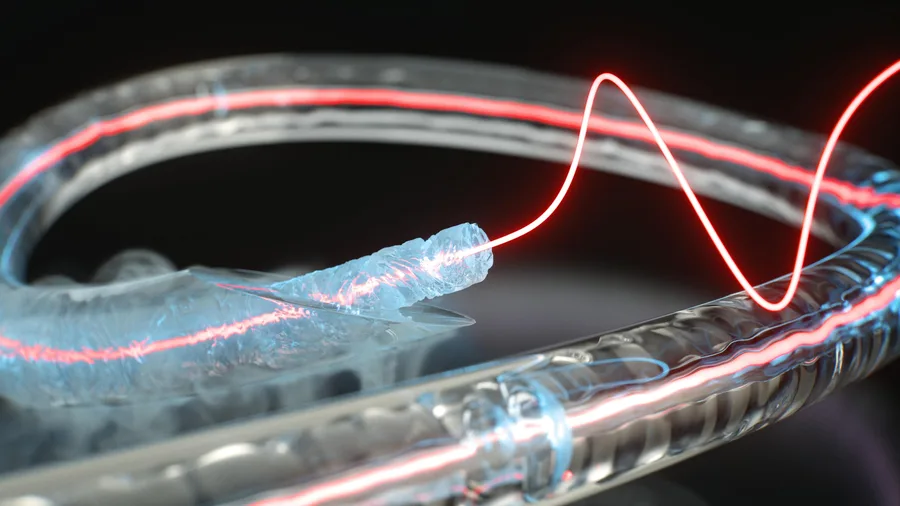
Nature Communications, Published online: 29 July 2026; doi:10.1038/s41467-026-76228-6 Authors demonstrate spatiotemporal shaping of terahertz pulses generated through gas-phase photoionization using a two-color ultrashort flying focus. The approach enables tunable spatial and temporal pulse characteristics, offering a versatile platform for nonlinear optics and advanced terahertz source engineeri…
A new type of organic thin film manipulates light in ways not currently possible on today’s silicon photonic chips—and placing it directly onto silicon opens the door to optical components such as modulators, amplifiers, and specialized light sources for quantum technologies.
Second-order nonlinear optical properties are fundamental for applications such as frequency conversions. Glass ceramics are of great interest for the development of optical elements with meter-scale dimensions for high power laser facilities.
Now, a research group has reported a reproducible and fast-technique to prepare transparent glass-ceramics, through a phase separation process leading to a…
This article discusses reasons for the fact that nonlinear frequency conversion processes in some crystals, such as frequency doubling, tend to become more efficient if the involved beams have short wavelengths.