semiconductor

Research covering 19 international standards bodies finds UK strengths in services and telecoms but weaker representation in hardware, semiconductors, and other foundational technologies. Aston Business School-led research calls for greater UK participation in global standards covering AI, semiconductors, 5G, and 6G Aston Business School -led research has called for a UK Standards Participation F…
Scientific Reports, Published online: 21 June 2026; doi:10.1038/s41598-026-58636-2 Low field magneto-tuneable photodetection in Dy 3+ doped Co-Zn ferrite based heterojunctions
Brewer Science, Inc. today announced it has entered into an agreement to acquire the semiconductor chemicals business line of Heraeus Epurio, a recognized technology leader in ultrapure electronic chemicals used in semiconductor manufacturing. The post Brewer Science to Acquire Semiconductor Chemical Business Line from Heraeus Epurio appeared first on Semiconductor Digest .
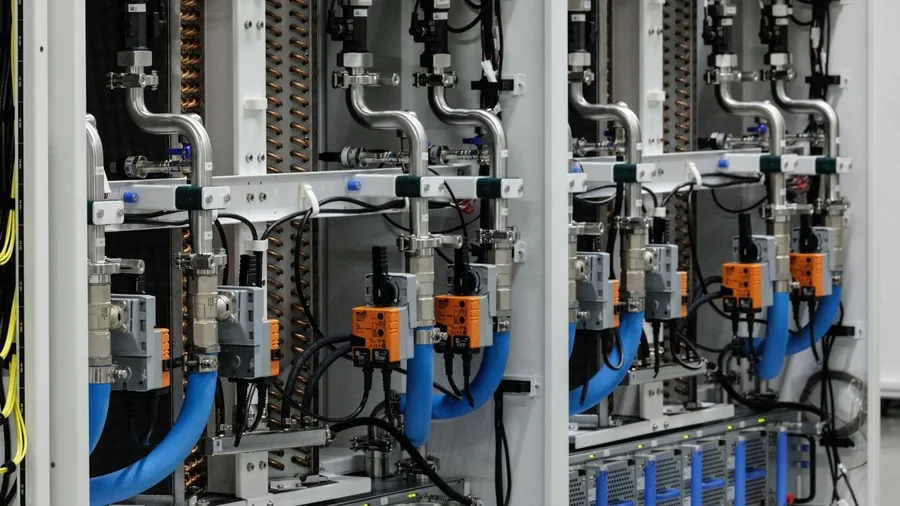
Researchers at the Korea Advanced Institute of Science and Technology (KAIST) have developed a technique to carve microscopic liquid-cooling channels directly inside silicon semiconductor chips. Interestingly, the computer architecture slashed the energy required for cooling by pumping ordinary, room-temperature water straight through the chip’s internal structure. “As the performance of AI semic…
A research team led by the The University of Tokyo has fabricated the world’s smallest semiconductor nanotube, according to a study published in the latest issue of Science. Using boron nitride (BN) nanotubes as a template, the researchers successfully synthesized single-walled molybdenum disulfide (MoS₂) nanotubes with a diameter of just 1 nanometer—roughly one hundred-thousandth the […]
Nature Communications, Published online: 19 June 2026; doi:10.1038/s41467-026-74238-y Most optoelectronic circuits remain constrained by conventional binary logic. Here, Lee et al. report a light-driven multi-state transistor that converts optical inputs into ternary logic states, enabling reconfigurable logic and in-sensor image processing within a single device architecture.
Nature Communications, Published online: 19 June 2026; doi:10.1038/s41467-026-74555-2 The simultaneous downscaling of the channel length (Lch) and contact length (Lc) remains an important challenge towards the industrialization of 2D transistors. Here, the authors report the realization of high-performance vertical metal–semiconductor field-effect transistors based on 2D MoS2 channels with sub-10…

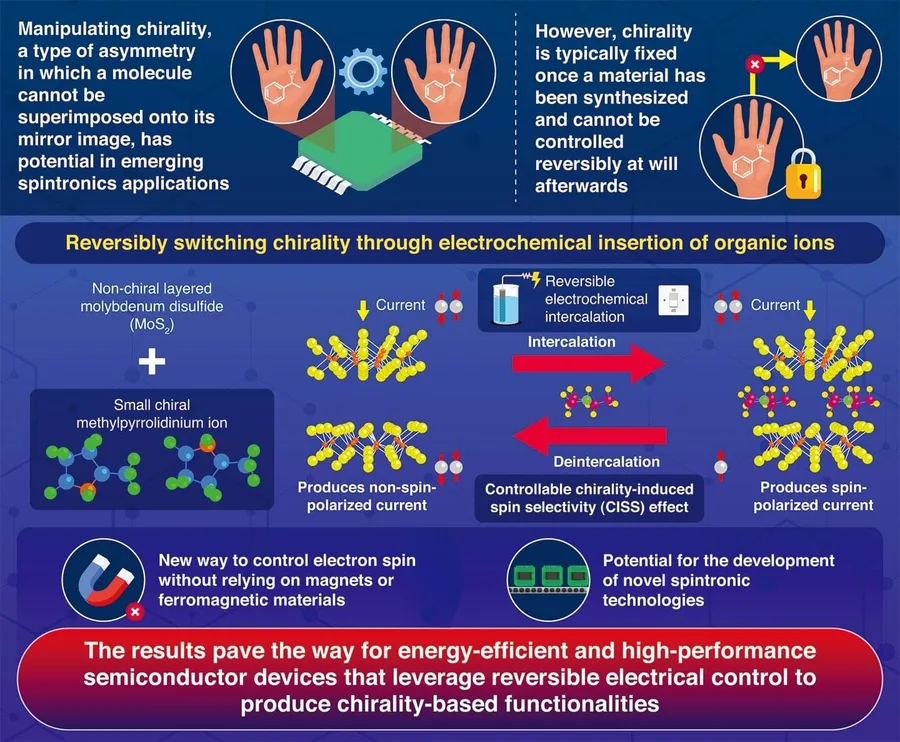
A newly developed method allows researchers to dynamically switch chirality—a particular lack of mirror symmetry—to generate spin currents in semiconductors, researchers from Science Tokyo report. Their approach relies on the reversible insertion and removal of small chiral molecules from the interlayer gaps of a layered, nonchiral semiconductor material using electrochemistry. The findings could…
Nature Reviews Physics, Published online: 17 June 2026; doi:10.1038/s42254-026-00949-2 Because gallium nitride light-emitting diodes (LEDs) have made most of the visible spectrum available to LEDs, they have become the backbone of modern lighting applications. This Review examines three effects governing the physics of GaN-based LEDs: polarization fields, carrier localization and non-radiative de…
Nature Communications, Published online: 17 June 2026; doi:10.1038/s41467-026-74151-4 The authors demonstrate transfer-printed yellow and red InGaN micro-LEDs on diamond substrates. These devices achieve a 1.5 Gbps data rate with an energy efficiency of 0.056 pJ/bit, enabling low-power, high-speed optical interconnects.

A 255 nm UV LED array is evaluated as a direct replacement for a 248.7 nm mercury lamp in a production wafer edge exposure system, with results addressing performance, cost, and process compatibility in a real manufacturing environment. The post Production Evaluation of 255 nm UV LEDs as a Replacement for Mercury Lamps for Wafer Edge Exposure Processes appeared first on Semiconductor Digest .
A research team led by Dr. Hyung Chul Yoon at the Korea Institute of Energy Research (KIER, President Yi Chang-Keun) has developed Korea's first technology for producing high-purity deuterated ammonia (ND₃), opening the door to domestic production and industrialization.

A Japan–U.S. collaborative research team has demonstrated the world’s first integrated spintronic probabilistic bit, or p-bit, fabricated on a silicon chip using semiconductor manufacturing processes. The team, consisting of researchers from Tohoku University and the National Institute of Standards and Technology, experimentally verified the operation of the p-bit, a key building block for probab…
Nature Electronics, Published online: 17 June 2026; doi:10.1038/s41928-026-01662-9 An array of 256 ring-electrode pairs fabricated on a complementary metal–oxide–semiconductor integrated circuit that can control local acidity and induce parallel enzymatic DNA synthesis can be used to encode a 169-byte text using DNA as a data storage medium.
A new technique could solve one of the biggest challenges in making future computer chips from ultrathin materials. Researchers found that coating molybdenum disulfide with oxygen or fluorine lets manufacturers remove just the top layer of atoms much more safely during plasma processing. The result is a cleaner, more controlled path toward smaller and more capable electronics.
research.ioSign up to keep scrolling
Create your feed subscriptions, save articles, keep scrolling.