Insider Brief PRESS RELEASE — Matt Pines, Alex Klokus and Dr. Alexander Wissner-Gross has launched Physical Superintelligence(PSI), an AI-focused physics research lab developing computational models and tools for designing and optimizing physical systems. PSI also announced $58 million in seed funding led by Breakthrough Energy Ventures, with participation from Dragon Global, Robot Ventures, Sola…
In tightly coupled multiphysics simulations, the conventional Monte Carlo assumption of piecewise-constant material properties is no longer valid, as temperature and density fields vary continuously in space. Current approaches to this problem each impose limitations on accuracy, generality, or computational efficiency. This work introduces the Lagrange Error-Adaptive Collision Sampling (LEACS) m…
For certain magnetic materials, calculating even basic properties has long demanded computational power that quickly becomes unmanageable. Now, utilising novel links between polymer physics and magnetism, calculations previously limited by system size are becoming tractable via faster algorithmic approaches. This work delivers an enhanced theoretical limit for modelling these complex interactions…
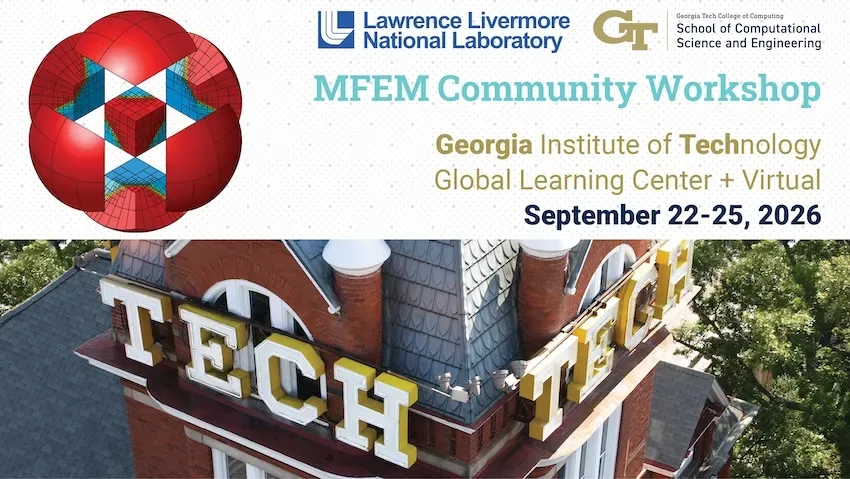
Georgia Tech is hosting the 2026 MFEM (Modular Finite Element Methods) Community Workshop, Sept. 22-25. MFEM supports research in computational physics, earth systems modeling, engineering, energy, and other fields.
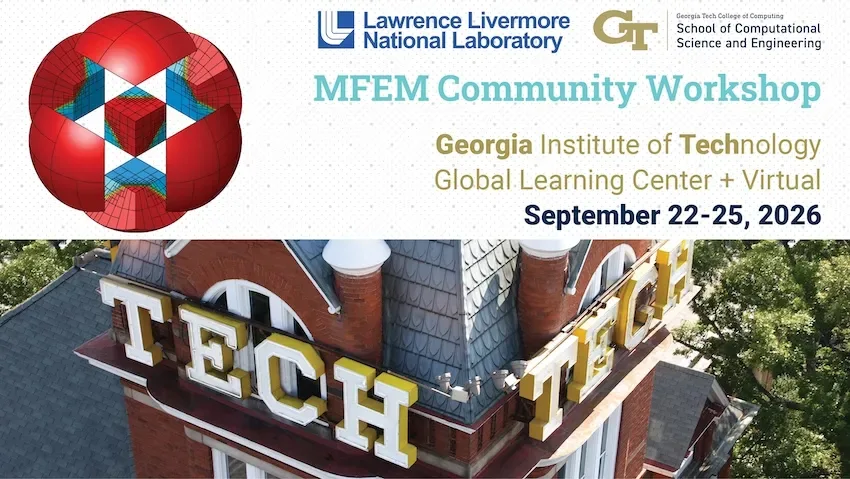
Georgia Tech is hosting the 2026 MFEM (Modular Finite Element Methods) Community Workshop, Sept. 22-25. MFEM supports research in computational physics, earth systems modeling, engineering, energy, and other fields.
Application deadline: Wednesday, September 30, 2026 Research group: Center for Theoretical Physics PAS Employer web page: Center for Theoretical Physics PAS, Warsaw, Poland Job type: Other PhD Tags: open quantum systems many-body physics quantum information quantum technologies computational physics tensor networks PhD Position PhD Candidate Openings: Open Quantum Systems & Many-Body Physics The …
A Newtonian N-body engine built around a sixth-order Yoshida integrator, an independent Decimal Bulirsch-Stoer reference, and conservative scientific claim controls. By Lino Avila | JX Planet X project | August 2026 JX N-Body Engine 0.1.0 is a reusable Newtonian propagation and numerical-validation toolkit written in Python. It grew out of the JX Planet X investigation, but its purpose is broader…
Trinity Communications
Natalie Klco, assistant professor of Physics and a member of the Duke Quantum Center, has received the 2026 Kenneth G. Wilson Award “for her pioneering contributions to digital quantum simulations of lattice gauge theories.”
Established with support from Physics Nobel Prize laureate Kenneth G. Wilson, whose computational approaches transformed theoretical physics, this inte…
Hi, I am CasioWave. I am currently a Master's student working towards a thesis in theoretical condensed matter. I am interested in quantum matter, non-pertubative techniques, renormalization group methods, and computational physics - broadly. I don't really know much yet, but I am trying. I... Read more
Jua replaced a file-based forecast pipeline with ClickHouse Cloud, cutting data delivery time from one hour to 20 minutes and historical query times from hours to seconds — giving energy traders a faster edge.
Jua replaced a file-based forecast pipeline with ClickHouse Cloud, cutting data delivery time from one hour to 20 minutes and historical query times from hours to seconds — giving energy traders a faster edge.
Scientific Reports, Published online: 13 June 2026; doi:10.1038/s41598-026-57932-1 Calibration-free physics-informed multi-task residual U-Net for simultaneous denoising and gas pressure retrieval from noisy voigt spectra
I would appreciate some help running and analysing the python scripts, eventually even implementing better visuals. Github repo link The longer runs (10e10) can take more than 24h on a decent CPU, 10e7 take a few minutes. There are some 256e3 grid simulations also of you have a decent gpu... Read more
_Zenodo_ 1. 2025Across physics, computation, and information science, observation is increasingly recognized as a non-neutral operation. However, a unified formulation describing how observer-dependent structure emerges from information processing remains lacking. In this work, we introduce Informational State Dynamics (ISD), a general framework in which observers are formally modeled as compress…
A new research model called PiGRAND merges physics guidance with graph neural diffusion to predict and control AM processes. The post PiGRAND Brings Physics Informed Graph Diffusion To AM appeared on Fabbaloo .
-
- Certificate
-
- On-Campus
- Accelerated
-
- 9 credits
-
- One–three semesters
Acquire Modern Skills to Solve Interdisciplinary Problems
Numerical programming and computer simulations are ubiquitous throughout physics. Michigan Tech's on-campus graduate certificate in Advanced Computational Physics explores the application of advanced computation to scientific problems in your research area.
W…
Juha Riippi; Alexandre Halbach; Valtteri Lahtinen; Asser Lähdemäki; Andrew Tweedie
1/1/2025
Quanscient provides a pure Python implementation without the layers of legacy code. It allows us to couple complex physics from the core up, making it easier to move from numerical optimization to physical prototyping
Quanscient Allsolve is a very intuitive and comprehensive simulation tool that can help to tackle the difficult non-linear properties of superconductors
Quanscient Allsolve transfor…
American Physics Society (APS) March meeting is one of the largest physics meetings in the world. To help the community quickly catch up on the work presented in this conference, Paper Digest Team processed all accepted work, and generated one highlight sentence (typically the main topic) for each. Readers are encouraged to read these machine generated highlights to quickly get the main idea of e…
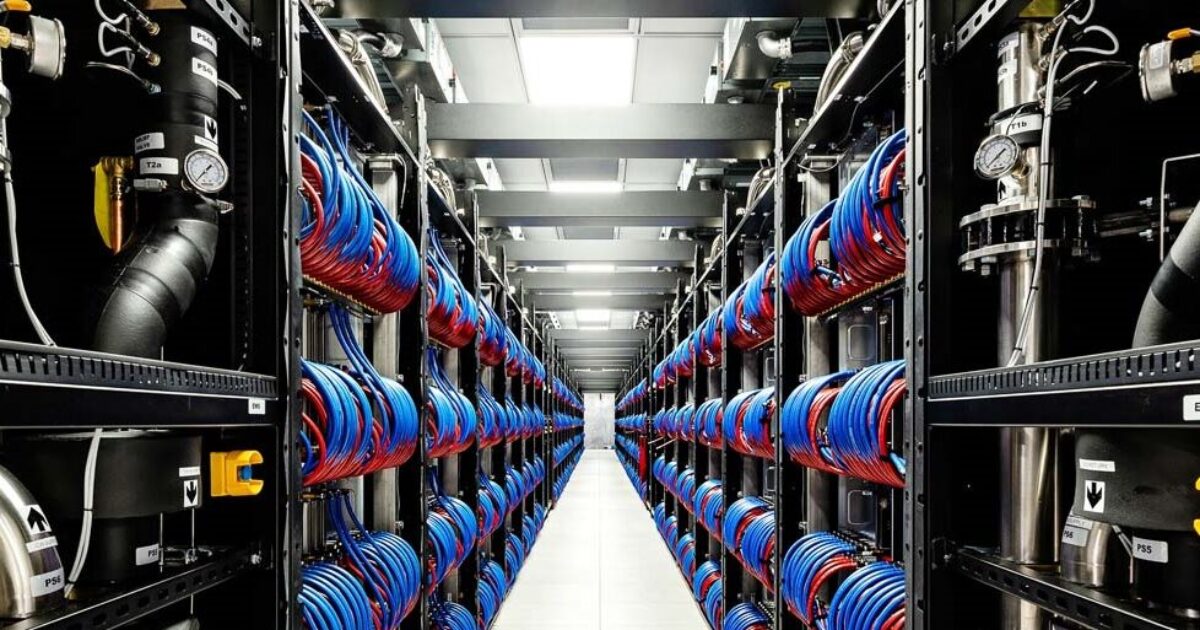
New exascale supercomputer will enable large-scale simulations and machine learning techniques to shed light on dark matter. The U.S. Department of Energy’s (DOE) Argonne National Laboratory is building one of the nation’s first exascale systems, Aurora. To prepare codes for the architecture and scale of the new supercomputer, 15 research teams are taking part in […] The post Argonne’s Aurora sup…




 research.io