In two weeks, I am giving two lectures about degenerate Fermi gases in a third-year undergraduate course on statistical mechanics. The textbook is the beautiful book by Schroeder. I want to highlight a few things that are amazing about the Fermi energy. 1. It is given by an incredibly simple expression. E F = ℏ 2 2 m (3π 2 n ) 2/3 2. Besides fundamental constants, it is only determined by the num…
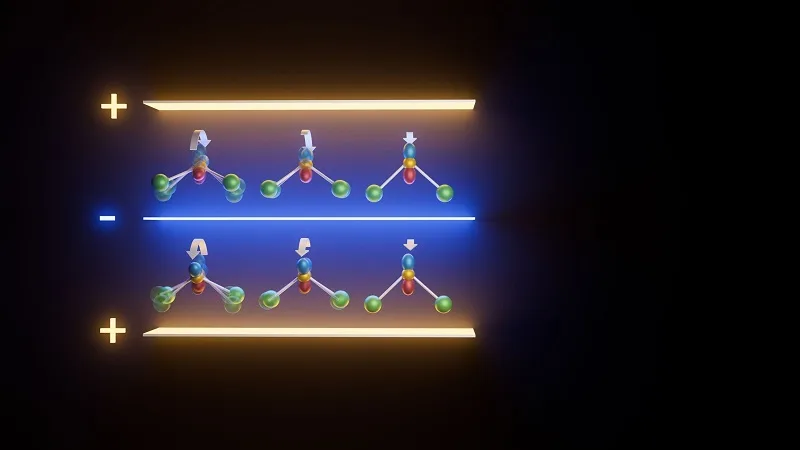
Atoms inside solid materials may appear fixed, but they are always moving. They vibrate together in patterns known as phonons. In some materials, these vibrations do more than move back and forth. The atoms can also travel in a tiny circular motion, creating what scientists call chiral phonons. “Chiral” means that something has a distinct […] The post Tiny Atomic Swirls Can Be Flipped with Electr…
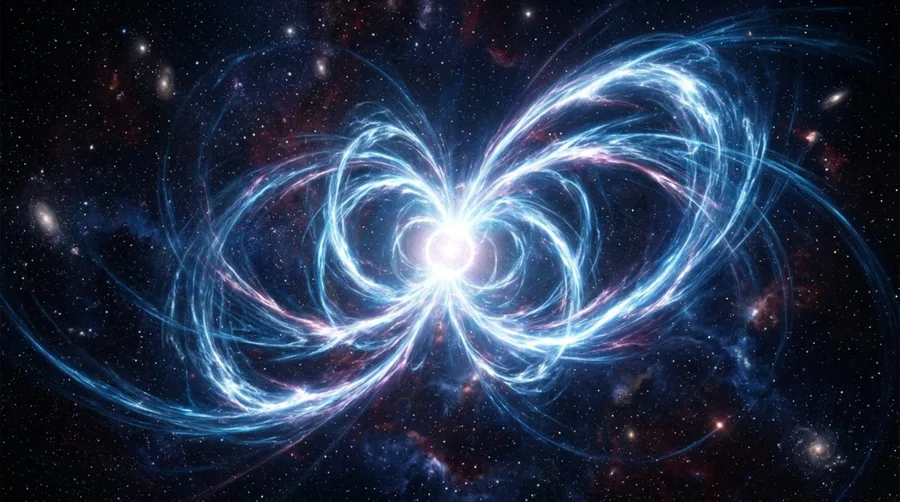
Nature Electronics, Published online: 08 September 2026; doi:10.1038/s41928-026-01703-3 A tiny magnetic film placed atop a microwave circuit can be used to create a compact source of correlated microwave signals that operates at room temperature.
Nature Electronics, Published online: 08 September 2026; doi:10.1038/s41928-026-01699-w A nanoplasma pulse generator that can produce current pulses with widths down to 6.4 ps and amplitudes exceeding 100 V can control field-free spin–orbit torque magnetization switching in magnetic heterostructures.
Scientists from Paul Scherrer Institute PSI have used an electric field to reverse the handedness of atomic vibrations known as chiral phonons. Chiral phonons link magnetism with atomic motion. The ability to control them opens new possibilities for phonon-based information technologies.
1) I've come up with the Meissner effect in my job recently: (Magnetic field lines through a conductor vs. field lines through a superconductor) 2) And today I saw a video of Mark Rober explaining the Coanda effect . (Fluid flow curving with the friction of a solid) And despite both effects coming from totally different processes, I've seen several similarities such as: how the flux lines in both…
I am trying to study why are traps required for Bose Einstein condensate, and what are the conditions for a trap to sustain a BEC? Equivalently, Without energy level how to define BEC?
Any comments are appreciated.
A laser pulse alters the magnetic behavior of electrons in an electron-doped cuprate superconductor, as observed through the study of collective magnetic excitations. Researchers investigated how photo-excitation impacts these materials, focusing on the interplay between light and magnetic properties within the cuprate’s electronic structure.
I want to compute the energies and eigenstates for non-zero total spin of the 1-dimensional XY model. The Hamiltonian for the 1-dimensional XY model is given by: \begin{align*}
H = -J \sum_{i=1}^{N} (S_i^x S_{i+1}^x + S_i^y S_{i+1}^y)
\end{align*} where $ S_i^x $ and $ S_i^y $ are the spin-1/2 components at site $ i $ . We assume $N$ is even and periodic boundary conditions ( $ S_{N+1} = S_1 …
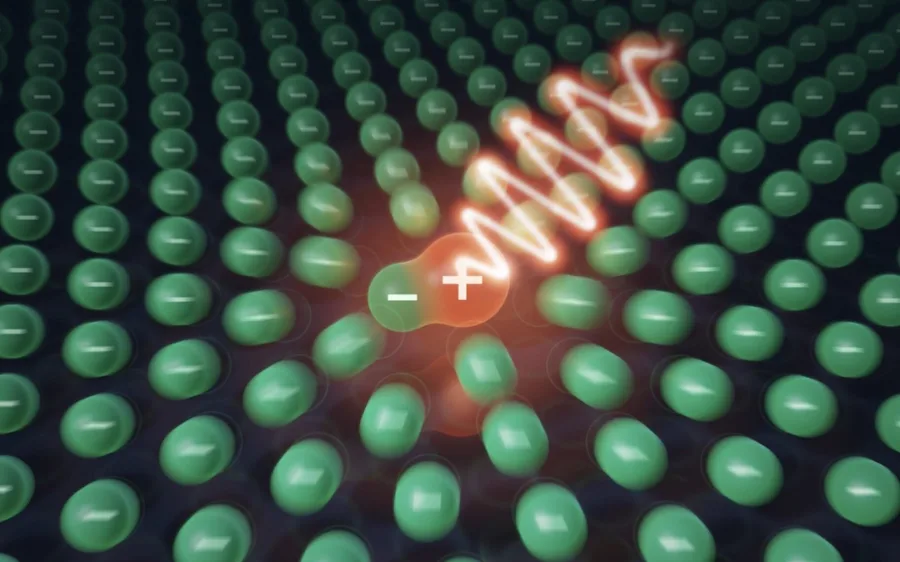
Electrons, particles that carry a negative electric charge, typically move through materials. At low densities and temperatures, however, the electrical repulsion between them can overpower their tendency to move, prompting them to arrange themselves into ordered patterns known as Wigner crystals. In contrast with ordinary crystals, which consist of atoms arranged in a repeating pattern, […]
Nature Communications, Published online: 05 September 2026; doi:10.1038/s41467-026-76391-w Researchers show how foundation atomistic models can predict heat transport and thermal expansion, using physics-based benchmarks and fine-tuning to reach first-principles accuracy.
Linear field theories Linear field theories form the classical counterparts to many important QFT's in condensed matter physics, modeling a wide range of materials, from the mundane (semiconductors), to the exotic (topological insulators and superconductors). Linear field theories are exactly soluble, and, when quantized, form great first approximations to complicated QFT's. Non-interacting parti…
Scientists have uncovered an unusual form of electron behavior in zirconium pentatelluride, a quantum material that can act as both an insulator and a conductor. Under temperatures near absolute zero and magnetic fields reaching 60 tesla, electrons produced quantum oscillations that continued even after conventional physics predicted they should disappear.
I am struggling to understand what does the area under the fermi distribution curve represent when plotted like this: I know that area under the Maxwell Distribution curve when plotted for speeds of molecule represent total number of molecules and it's supposed to stay constant when temperature is increased. I understand it as Y-axis represent number of molecules per unit speed and X-axis represe…
According to Wikipedia: A magnetic domain is a region within a magnetic material where individual magnetic moments of the atoms are aligned with one another and point in the same direction thus resulting in uniform magnetisation in that region. Below Curie temperature, a piece of magnetic material such as iron spontaneously divides into separate magnetic domains rather than stay in a state with m…
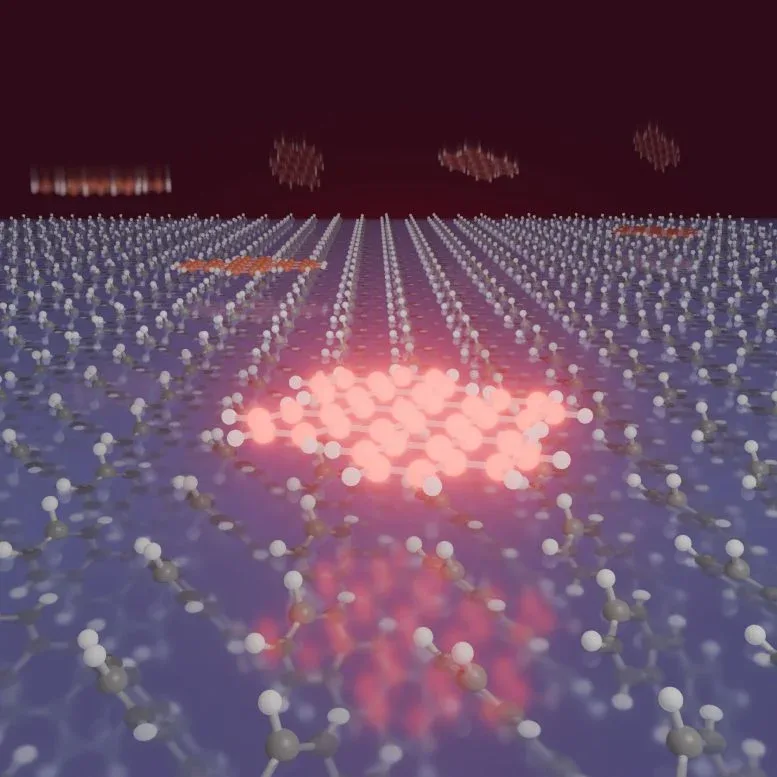
An ultra-clean crystal surface allowed individual molecules to preserve quantum coherence at the fundamental Fourier limit. A molecule placed on a surface should be easier to probe and manipulate than one hidden inside a solid or suspended in vacuum. In practice, however, surface contamination creates an unstable, noisy environment that can quickly degrade the molecule’s [...]


 research.io