Nature Communications, Published online: 07 September 2026; doi:10.1038/s41467-026-77574-1 This work demonstrates an antisite-defect suppression strategy for Bi2Te3 single-crystal thin films, enabling flexible thermoelectric generators that deliver high power output and long-term bending durability for wearable microelectronic applications.
A cooling cup of coffee seems to follow a simple rule: heat moves from warmer areas to cooler ones. This familiar process has been described successfully for about two centuries. But at the tiny scales found inside modern computer chips, heat can behave in much stranger ways. A new theoretical framework developed by Auburn University […] The post Heat Can “Remember” Its Past, New Theory Reveals a…
From its unique properties to the physics of phase transitions, Limei Xu explains how studying water can reveal fundamental laws of nature. The post Limei Xu: Unraveling water’s hidden physics appeared first on Advanced Science News .
In my textbook it's written Work done is always calculated on the displacement of the body parallel or anti-parallel to the direction of the force. And, according to the formula it is : $$\mathbf{F \cdot S}$$ or $$Fs \cos \theta$$ And work done by torque is given as : $$\tau \theta$$ Now let's take a case when a cylinder with fixed center of mass and radius $R$ is rotated with a tangential force…
According to this web article: http://hyperphysics.phy-astr.gsu.edu/hbase/thermo/phase.html#c6 "In the process of heating water from 0 to 100 C, 100 calories of energy must be added. Part of that energy increases the kinetic energy of the molecules, and some adds to the potential energy." "The net gain in kinetic energy is then 16.7 calories/gram when the water is heated from 0 to 100 C. The rema…
The Autocremation Paradox (ACP) is a thought experiment designed to close the redundancy problem of the bootstrap paradox. Where standard loops persist an unchanged object or a piece of information without origin, the ACP lets the thermodynamic remainder of an event—the ashes of a cremation—function as the material cause (propellant) of that same event. The resulting State-Change Identity makes t…
The second law of thermodynamics can be stated as the entropy of the universe $S$ obeys : $$ \Delta S\geq 0$$ Now, I think it's important what $S$ is a function of time $t$ (then the arrow of time is pressumed): $$ S(t_2) \geq S(t_1)$$ On the otherhand, if entropy is a function of state variables then (I'd argue it gives rise to an arrow): $$ S(U_2,V_2, \dots) \geq S(U_1,V_1, \dots) $$ where $U$…
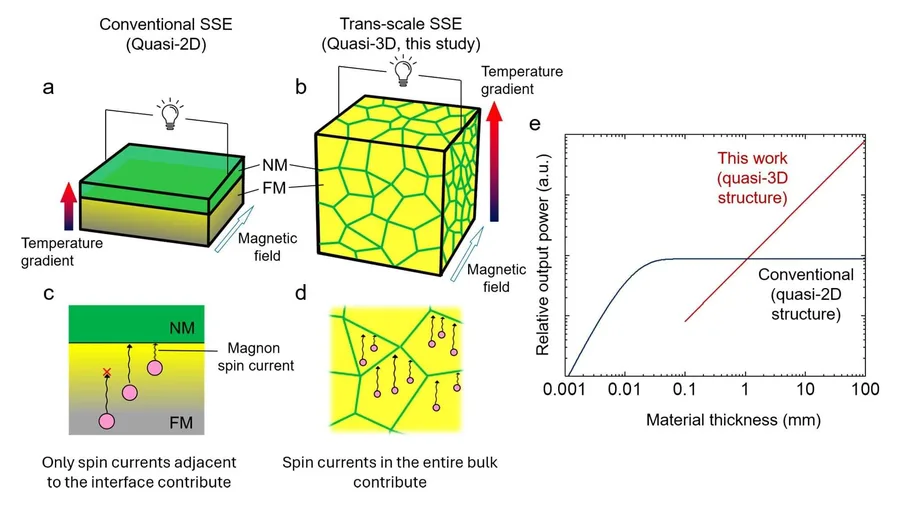
A joint research team from NIMS and the University of Tokyo has developed a new composite in which three-dimensional nano-interfaces are distributed throughout the material by coating the surfaces of magnetic-insulator powders with a metal and sintering them. Using this structure, the team succeeded in observing thermoelectric conversion driven by spins in an insulator, a […]
Can a superconductor turn heat flow into a detectable electrical signal without the motion of magnetic vortices? This response, known as the Nernst effect, was long thought to be hidden because superconductors carry current without a voltage drop and screen the resulting electrical current. A recent…
I am trying to derive the Maxwell–Boltzmann statistics starting from the microcanonical ensemble. Consider an isolated system $A^{(0)}$ , with fixed total particle number $N_T$ , volume $V_T$ , and energy $E_T$ . According to the microcanonical postulate, all accessible microstates of the total isolated system are equally probable. The total system is divided into two subsystems, $A$ and $B$ . Le…
Consider a isolated system of gas of total energy E in box of volume V.According to Liouville's Theorem the density in 6N dim phase space volume is conserved with Hamiltonian flow. Indeed we take uniform density ρ at t=0 (we are already starting from high entropy state assuming we have no information to give extra weight to some microstate) and so ρ is forever uniform and constant. Infact its equ…



 research.io