Nature Communications, Published online: 11 June 2026; doi:10.1038/s41467-026-72581-8 Scalable perovskite solar cell production is limited by moisture sensitive interfacial layers. Li et al. develop a low hygroscopic solvent system enabling ambient blade coating of precursors, including self-assembled monolayers and passivation layers, yielding high device efficiency.
Nature Communications, Published online: 01 June 2026; doi:10.1038/s41467-026-73276-w Here, the authors present a polymeric interface that enhances the efficiency and stability of perovskite solar cells, enabling durable large-area flexible modules and high efficiency in rigid and tandem devices.
Nature Communications, Published online: 25 May 2026; doi:10.1038/s41467-026-73620-0 Formamidine-based perovskite solar cells promise high efficiency, but additive-induced deprotonation disrupts precursor stability and device performance. Dong et al. use a hydrolyzing ester additive to regulate proton transfer, stabilizing the precursor and achieve efficient, durable devices.
Nature Communications, Published online: 18 May 2026; doi:10.1038/s41467-026-73210-0 Tin-lead perovskites enable tandem devices to surpass the Shockley-Queisser limit, but oxidation of tin severely degrades film quality and performance. Jiang et al. stabilize bulk and surface with two natural antioxidants, boosting both single- and tandem-device efficiency and stability.
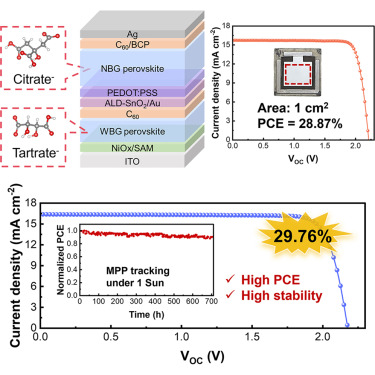
Nature Nanotechnology, Published online: 27 April 2026; doi:10.1038/s41565-026-02165-6 Chemical hardness engineering synchronizes the growth of two perovskite layers in tandem solar cells, suppressing composition gradients and defects, and enabling certified efficiencies of 30.3% (rigid) and 28.0% (flexible) with improved stability.
Nature Communications, Published online: 22 April 2026; doi:10.1038/s41467-026-72159-4 Perovskite solar cells face efficiency losses in ambient air because their precursors are highly moisture- and oxygen-sensitive. Liu et al. use an ionic-liquid additive to stabilize precursor chemistry, enabling robust processing and high-performance devices.
Nature Communications, Published online: 20 April 2026; doi:10.1038/s41467-026-72097-1 Co-deposited perovskite solar cells suffer from self-assemble monolayer (SAM) aggregation that weakens interfacial adhesion and limits performance. Zhuang et al. design an asymmetric SAM and a crosslinking additive to curb aggregation, enabling efficient, stable devices.
Think about what happens inside a solar cell the moment light hits it. Photons jostle electrons loose from their atoms, and those electrons have to travel, quickly, through a crystalline lattice before they recombine and the energy is wasted as heat.
In a tandem cell built from two stacked layers of perovskite, a man-made mineral compound that can be tuned to absorb different wavelengths, this jo…
Tiny crystal “seeds” could solve a hidden flaw in perovskite solar cells—unlocking high efficiency at larger scales. Traditional perovskite solar cells (PSCs) are built with the electron transport layer underneath the perovskite light-absorbing layer and the hole transport layer on top. While this design has delivered strong performance in laboratories, it faces challenges when scaled [...]
Defect-filled lead-halide perovskites rival silicon solar cells because domain walls inside the material separate and guide charges. Researchers visualized these charge-transport networks using a novel silver-staining technique, resolving a long-standing efficiency mystery. Perovskites made from lead halides are produced through low-cost solution processing and contain many defects. Even so, they…
Why Some Perovskite Solar Materials Fall Apart Under Thermal Evaporation — And What It Means for Solar Tech
Metal halide perovskites are a class of materials that have captured huge interest in solar energy research because of their remarkable ability to convert sunlight into electricity. In less than a decade, perovskite solar cells have achieved efficiencies close to traditional silicon panels,…
The publication ABC España has featured IMDEA Materials and the Institute's Principal Investigator, Prof. Harun Tüysüz, in its recent article on promising applications for Perovksite materials.
Perovskites are crystal structures that can be manufactured in labs for making solar panels. They are relatively cost-effective, and efficient, and could provide a reliable thin-film alternative to the more common silicon-based solar panels. However, perovskite solar cells face a few challenges that must be addressed before they can become a competitive commercial PV technology. […]
Looking back, I realized that I haven't written much about halide perovskites , which is quite an oversight given how much research impact they're having. I'm not an expert, and there are multiple extensive review articles out there (e.g. here , here , here , here , here ), so this will only be a very broad strokes intro, trying to give some context to why these systems are important, remarkable…
I ended up spending more time catching up with people this afternoon than going to talks after my session ended, but here are a couple of highlights: There was an invited session about the metal halide perovskites , and there were some interesting talks. My faculty colleague Aditya Mohite gave a nice presentation about the really surprising effects that light exposure has on the lattice structur…
Perovskite (say it: pə-ˈräv-ˌskīt, -ˈräf-). It may never become a household word, and the chemical formulas (eg., CH3NH3PbI3−xClx ) are as long as the name. But if you find yourself, in the not-so-distant future, adding new-and-improved solar panels to your roof, they may well contain a perovskite layer. If they do, it will be these “wonder materials” that will make your panels cheap enough to ma…
materialsperovskites
research.io
Sign up to keep scrolling
Create your feed subscriptions, save articles, keep scrolling.











 research.io