Although pharmacological treatments for insomnia remain widely prescribed, their long-term use is constrained by risks of tolerance, dependence, and residual daytime effects. This has prompted growing interest in non-pharmacological interventions that target insomnia’s underlying mechanisms. This narrative review examines five physical factor therapies for insomnia: auditory stimulation, photothe…
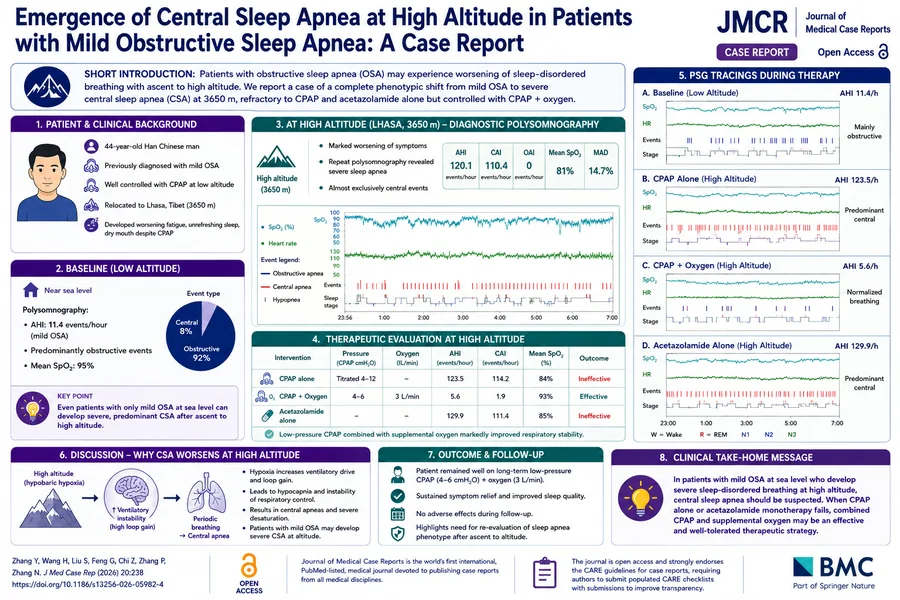
This JMCR case highlights a dramatic shift from mild obstructive sleep apnea at sea level to severe central sleep apnea at high altitude, refractory to CPAP and acetazolamide but successfully treated with CPAP plus supplemental oxygen.
Millions of people around the world struggle with obstructive sleep apnea, a serious sleep disorder that causes breathing to repeatedly stop and start during sleep. Many people with the condition snore loudly, wake up feeling exhausted, or feel sleepy during the day even after spending many hours in bed. In severe cases, sleep apnea can […] The post New Bedtime Pill May Treat Sleep Apnea Better a…
medicinepharmacologysleep-disorders
Frontiers in Neuroscience | New and Recent Articles
BackgroundSleep disorders represent a common and impactful complication following acute ischemic stroke (AIS). This study aimed to identify clinical risk factors and evaluate the predictive value of serum hypocretin (Hcrt), neurofilament heavy chain (NfH), and interleukin-1 beta (IL-1β) for post-stroke sleep disorders.MethodsWe conducted a retrospective observational study of 256 patients with AI…
ObjectiveThis study aimed to evaluate the effectiveness of pharyngeal musculature and genioglossus exercising as a postoperative rehabilitation intervention for patients with obstructive sleep apnea-hypopnea syndrome (OSAHS) following uvulopalatopharyngoplasty (UPPP)—a setting with limited prior evidence.MethodsThis is a retrospective cohort study conducted in the first people’s Hospital of Linpi…
Melatonin is widely used across the world for children who have trouble sleeping. Learn about the recent research and guidelines for healthcare providers.
A study has revealed that a common sleep disorder may be affecting brain health more seriously than many people realize. Obstructive sleep apnea, often called OSA, is a condition that disrupts breathing during sleep. While it is widely known for causing loud snoring and poor sleep, new research suggests it can also harm thinking, memory, […] The post Common sleep problem could quietly damage your…
A Sleep Disorder Evaluation in Maryland is a comprehensive, 90-minute clinical assessment designed to move beyond guesswork and pinpoint the exact root cause of persistent sleeplessness, distinguishing conditions like insomnia, sleep apnea, and restless legs syndrome. This systematic diagnostic investigation is crucial because sleep disorders are often intertwined with high-stress Maryland life f…
Insightful Psychiatry offers comprehensive Sleep Disorder Evaluation in Florida to move beyond guesswork and identify the precise root cause of sleeplessness. This systematic evaluation follows clinical protocols to distinguish between different disorders (Insomnia, Circadian, Breathing, Movement) and screen for co-occurring mental health conditions. By analyzing unique Florida lifestyle factors …
A Sleep Disorder Evaluation in Washington is a detailed medical assessment to identify the root cause of chronic exhaustion, investigating sleep architecture, physiology, and underlying conditions. We evaluate common disorders including Insomnia, Sleep Apnea, and Circadian Rhythm Disorders (common with Shift Work). The process includes a Clinical Assessment (sleep history, validated measures) and…
A Sleep Disorder Evaluation in Colorado is a comprehensive diagnostic process designed to identify the specific root causes of persistent sleep issues, which are often exacerbated by the unique high-altitude environment and active local lifestyle. This systematic evaluation follows clinical guidelines, integrating detailed clinical interviews and standardized tools to distinguish between differen…
The Sleep Disorder Evaluation in New York is a structured diagnostic investigation designed to move beyond generic advice and uncover the physiological root cause of chronic exhaustion and poor sleep for New Yorkers. It employs a multi-layered process including an In-Depth Clinical Sleep Interview, the use of Validated Screening Tools, and a crucial focus on Differential Diagnosis to distinguish …
A Sleep Disorder Evaluation in Texas is a comprehensive clinical assessment designed to identify the root causes of sleep problems by investigating the complex interplay between your biology, lifestyle, and the unique Texas environment (e.g., climate, work culture, stress). The goal is to move beyond simple screening to provide an accurate diagnosis for effective treatment.
Tossing and turning th…
A comprehensive Sleep Disorder Evaluation is a scientific investigation to uncover the root cause of chronic sleeplessness, moving beyond simple habits. Our structured 60-90 minute process includes an In-Depth Clinical Interview and crucial Differential Diagnosis to distinguish Insomnia from conditions like Sleep Apnea, RLS, and Circadian Rhythm Disorders. This assessment provides a clear, person…
medicinepsychiatrysleep-disorders
Hope Center for Neurological Disorders | Washington University in St. Louis
Pain and sleep disturbances often go hand in hand — more than 30% of the U.S. population lives with pain, and a majority of those with pain also report sleep disorders — but the relationship between the two has remained largely unexplored. Now researchers at WashU Medicine have developed a new mouse model that mirrors […]
medicinepainsleep-disorders
The Scientific World - Let's have a moment of science
Insomnia is a sleep disorder that causes a person to have difficulty falling asleep, which may include trouble falling asleep; having trouble remaining asleep; waking up too early and not being able to return to sleep . Insomnia can affect people of any age. It can negatively affect certain aspects of life, such as work or school performance, and may also play a role in the incidence of some othe…
Delayed sleep phase syndrome it's a disorder of sleep time that occurs when a person's circadian rhythms (sleep or wake cycle) delay from the typical day-night process. This write-up tells you the signs of DSPS and the causes of it. The post Delayed Sleep Phase Syndrome (DSPS) appeared first on Circle .